
The biceps tendon at the shoulder
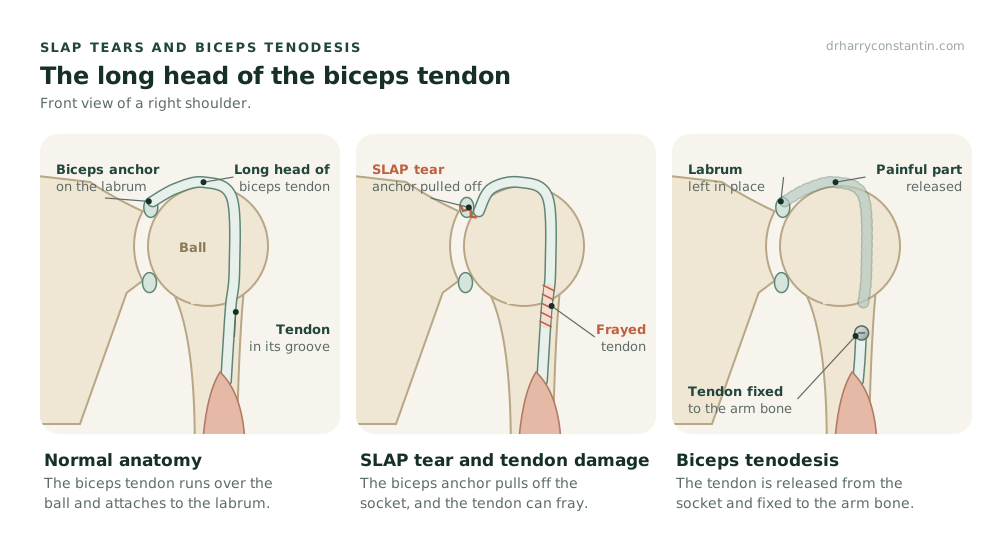
The biceps muscle at the front of the arm has two tendons at the shoulder. The short head attaches to a bony point at the front of the shoulder blade (the coracoid), while the long head of the biceps travels through a groove at the front of the upper arm bone and into the shoulder joint, where it attaches to the top of the socket and the labrum, the rim of cartilage that deepens the socket.
Because of this path, the long head of the biceps tendon is a common source of pain at the front of the shoulder. Both the tendon itself and its attachment to the labrum can be damaged.
What is a SLAP tear?
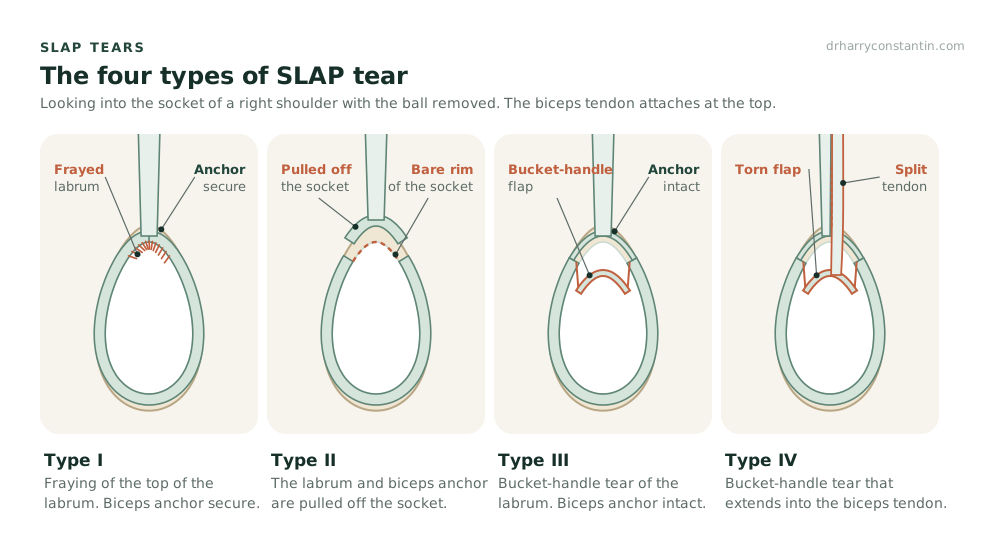
SLAP stands for Superior Labrum, Anterior to Posterior. It is a tear of the top part of the labrum, where the biceps tendon anchors to the socket, extending from the front to the back. SLAP tears are commonly described in four types:
- Type I: fraying and wear of the top of the labrum, with the biceps anchor still secure
- Type II: the biceps anchor has pulled away from the socket. This is the most common type
- Type III: a bucket-handle tear of the labrum, with the biceps anchor intact
- Type IV: a bucket-handle tear that extends into the biceps tendon
Biceps tendon problems
The long head of the biceps tendon can cause pain in several ways, often alongside a SLAP tear or a rotator cuff tear:
- Biceps tendinopathy (tendonitis): inflammation and degeneration of the tendon from repetitive use or age-related wear
- Partial tears: fraying or splitting of the tendon
- Instability (subluxation): the tendon slips out of its groove, usually because of a tear of the surrounding soft tissues or the subscapularis tendon
- Rupture: a complete tear of the tendon, which may cause a bulge in the arm (the "Popeye" sign). It is often less painful once it has torn
Causes
- Repetitive overhead activities such as throwing, swimming, tennis and volleyball
- Heavy lifting and gym work, including bench press, dips and pull-ups
- A fall onto an outstretched arm or a direct blow to the shoulder
- A sudden pull on the arm, such as catching a heavy object
- Age-related wear of the labrum and tendon, commonly from the 40s onwards
- Other shoulder problems, including rotator cuff tears and impingement
Symptoms
- Pain at the front or top of the shoulder, sometimes spreading down the front of the arm
- Pain with overhead activity, lifting, throwing or reaching behind
- Clicking, popping, catching or locking in the shoulder
- A feeling of weakness or instability with overhead activity
- In throwing sports, a so-called "dead arm": the pain comes on, then the arm loses all its power and velocity in the throw
- Night pain and difficulty lying on the affected side
Diagnosis
At your consultation Dr Constantin will discuss your symptoms, activities and how the problem started, and examine the shoulder using specific clinical tests for the biceps tendon and labrum, as well as assessing the rotator cuff.
An MRI scan is used to assess the labrum, biceps tendon and rotator cuff. Damage to the biceps tendon does not always show clearly on scans, so the clinical examination is particularly important, and the tendon can be fully assessed at the time of arthroscopy.
Non-surgical treatment
Most SLAP tears and biceps tendon problems are initially treated without surgery, and many settle. Treatment includes:
- Rest from aggravating activities, followed by a gradual return
- Physiotherapy to restore shoulder movement, stretch a tight posterior capsule (sleeper stretches), and strengthen the rotator cuff and shoulder blade muscles
- Anti-inflammatory medication
- An image-guided cortisone injection into the joint or around the biceps tendon
Surgery is considered when pain and loss of function persist despite a good trial of non-surgical treatment, usually over three to six months.
Biceps tenodesis
Biceps tenodesis is an operation that aims to relieve pain from both SLAP tears and long head biceps tendon problems. The painful upper portion of the tendon is released from its attachment inside the shoulder joint, removing the damaged tendon and the pull on the torn labrum. The healthy tendon is then securely reattached (tenodesed) to the upper arm bone (humerus), outside the joint.
Because the tendon is reattached, the biceps muscle keeps its normal length, strength and appearance. For most patients, tenodesis gives more predictable pain relief and a quicker, simpler recovery than attempting to repair the labrum, and it is well suited to all patients.
The surgery
The operation is performed under a general anaesthetic, usually with a nerve block to keep the shoulder comfortable afterwards. A shoulder arthroscopy (keyhole surgery) is first performed to assess the joint, the labrum, the biceps tendon and the rotator cuff, and to treat any other problems found. The biceps tendon is then released and fixed to the humerus using a strong suture anchor. It is usually day surgery or a single overnight stay, and it is often combined with other procedures. Dr Constantin routinely performs a biceps tenodesis at the same time as a rotator cuff repair.
Risks and complications
Biceps tenodesis is a common operation, but as with all surgery there are risks. These will be discussed with you before surgery and include:
- Persistent pain or tenderness at the site of the tenodesis, which usually settles with time
- Failure of the fixation, causing a change in the shape of the biceps muscle
- Stiffness of the shoulder
- Nerve injury, usually temporary
- Fracture of the humerus at the fixation site (rare)
- Infection, blood clots and anaesthetic complications (rare)
Recovery and rehabilitation
Rehabilitation follows Dr Constantin's Biceps Tenodesis Rehabilitation Protocol and is supervised by your physiotherapist. The biceps fixation is protected for the first three months by avoiding resisted biceps work and forced straightening of the elbow.
The full protocol is available on the Rehabilitation page for you and your physiotherapist.
Returning to everyday activities
- Work: desk work often from 1–2 weeks; heavy manual work usually around 3 months
- Driving: once you are out of the sling and can control the vehicle safely
- Swimming: breaststroke from 3 weeks; freestyle from 7 weeks
- Gym and sport: light weights from 7 weeks; all sports, including throwing, racquet and contact sports, from 3 months
Recovery time can be longer if other procedures, such as a rotator cuff repair, are performed at the same time. In that case, the rehabilitation for the combined procedure will be followed.
Frequently asked questions
What is the difference between a SLAP tear and a biceps tendon problem?
They are closely linked. The long head of the biceps tendon attaches to the top of the labrum. A SLAP tear is a tear of the labrum at this attachment point, while biceps tendinopathy is damage or inflammation of the tendon itself as it runs down the front of the shoulder. The two often occur together, and both can be treated with a biceps tenodesis.
Do I need surgery for a SLAP tear?
Not always. Many SLAP tears, particularly those related to age-related wear, settle with physiotherapy, activity modification and sometimes an injection. Surgery is considered when pain persists despite a good trial of non-surgical treatment.
Will I lose strength after a biceps tenodesis?
Most patients have no noticeable loss of strength for everyday activities, work or sport. The biceps muscle remains attached and working. Only the painful upper part of the tendon is removed from the shoulder joint.
Will my arm look different?
Because the tendon is secured to the bone, the normal contour of the biceps muscle is maintained. This avoids the "Popeye" bulge that can occur when the tendon ruptures or is simply released (tenotomy).
Is it day surgery?
Biceps tenodesis is usually performed as day surgery or with a single overnight stay, often at the same time as other shoulder procedures such as a rotator cuff repair.
How long will I wear a sling?
Your sling is worn for two weeks, removed only for hygiene and your exercises, and then weaned over the following weeks.
When can I return to work and driving?
Desk-based work is often possible within one to two weeks. Driving is generally possible once you are out of the sling and can control the car safely. Heavier manual work usually requires around three months, as resisted biceps work is avoided until then.
When can I swim or return to sport?
Breaststroke can usually start from three weeks and freestyle from seven weeks. Light cardio and non-contact drills are allowed from seven weeks, and most patients can return to all sports, including the gym, from three months.
Is this covered by my health fund, WorkCover or CTP?
Dr Constantin operates at the Mater Hospital, North Sydney, for patients with private health insurance, workers compensation and CTP claims, and at Canterbury Hospital for Medicare-only patients. For costs and cover, see Health insurance & fees or call the rooms to talk through your options.
Book an appointment
If you have pain at the front of your shoulder, clicking or catching, or a SLAP tear on your scan, Dr Constantin can assess the cause and recommend the right treatment. Please contact Dr Constantin for an assessment, or call (02) 9409 0503.
If you need surgery, it will be performed at the Mater Hospital or Canterbury Hospital.
Related pages
The information on this page is general in nature and is not a substitute for individual medical advice. Recovery timeframes are a guide only and will be tailored to you.
Talk to Dr Constantin about your shoulder
A GP or specialist referral is needed to claim a Medicare rebate. Consultations are available in North Sydney, Kogarah and Miranda.