
What is the rotator cuff?
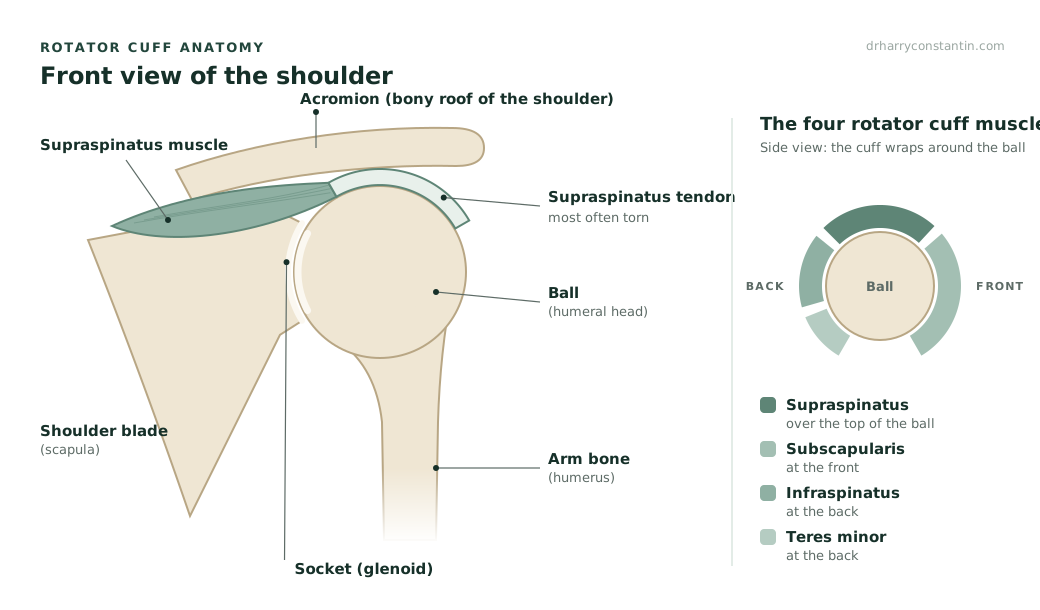
The rotator cuff is a group of four muscles whose tendons wrap around the ball of the shoulder joint. Together they keep the ball centred in the socket and let you lift and rotate your arm.
If one or more of these tendons is damaged, everyday movements like reaching overhead, getting dressed or sleeping on your side can become painful and difficult.
Common rotator cuff problems
Rotator cuff tears
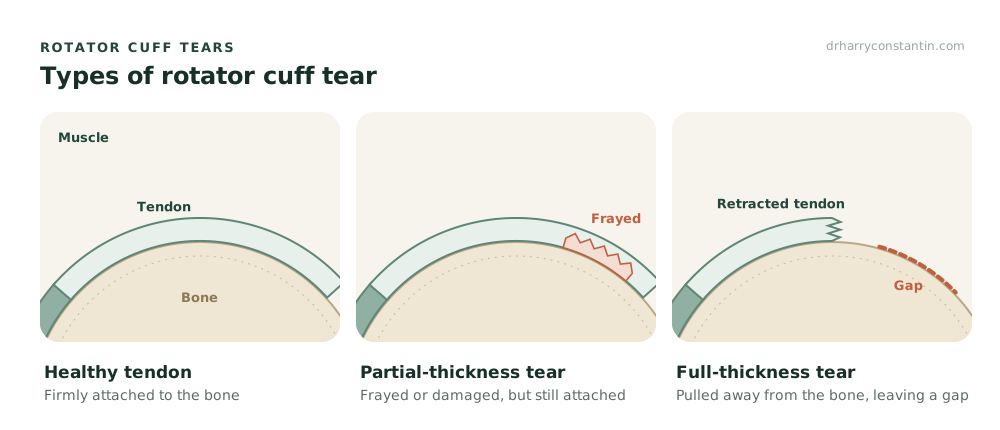
- Partial-thickness tears. The tendon is frayed or damaged but still attached to the bone.
- Full-thickness tears. The tendon has come away from the bone completely, leaving a gap.
- Acute tears. These follow a specific injury, such as a fall onto an outstretched arm or lifting something heavy.
- Degenerative tears. These develop gradually as the tendon wears over time, and they're more common after the age of 40.
Subscapularis tears
The subscapularis is the largest and strongest rotator cuff tendon. It sits at the front of the shoulder, turns the arm inwards and helps keep the ball centred in the socket. Tears can follow an injury, such as a fall or a forceful twist of the arm outwards, particularly in younger and active people, or occur alongside other rotator cuff tears as the tendons wear with age.
Subscapularis tears often cause pain at the front of the shoulder, difficulty reaching behind your back or tucking in a shirt, and weakness pressing the hand against the stomach. They are often linked with problems of the nearby biceps tendon, which can slip out of its groove when the subscapularis is torn.
Calcific tendinitis
Calcium deposits can build up within the rotator cuff tendons. The pain can be severe, particularly while the deposit is being reabsorbed. Calcific tendinitis is most common in people aged 30 to 50.
Symptoms
- Pain at night, often bad enough to disturb sleep, especially when lying on the affected side
- Pain when raising the arm or lowering it from overhead
- Weakness when lifting or rotating the arm
- Loss of shoulder movement
- A clicking or catching sensation with some movements
What causes rotator cuff tears?
- Age-related wear. Blood supply to the tendons decreases with age, which slows healing of minor damage.
- Repetitive overhead activity. Throwing sports, tennis, swimming, weight training and overhead work all load the tendons.
- Bone spurs. Spurs under the acromion (the bony roof of the shoulder) can rub on the tendon.
- Injury. Falls, dislocations or sudden heavy lifting can tear the tendon.
Assessment
Your consultation starts with a detailed history and a clinical examination to assess tenderness, range of movement and the strength of each rotator cuff muscle.
Imaging usually includes X-rays, to check the bony anatomy and look for calcium deposits, and an ultrasound or MRI to show the size of any tear and the quality of the tendon and muscle.
The subscapularis needs its own specific examination tests, such as the belly press, lift-off and bear hug tests, because some subscapularis tears are hard to see on scans and are only fully assessed at the time of arthroscopy.
Non-surgical treatment
Many rotator cuff problems, particularly partial tears and degenerative tears, improve without surgery:
- Changing or reducing aggravating activities
- Anti-inflammatory medication
- A structured physiotherapy program focused on strengthening and shoulder mechanics
- Corticosteroid injection to settle pain and inflammation
When is surgery recommended?
Surgery may be recommended when:
- Symptoms continue despite several months of appropriate non-surgical treatment
- There is a full-thickness tear, particularly in a younger or active patient
- There is significant weakness or loss of function
- The tear is acute and follows an injury, where early repair gives the best chance of healing
- The tear is large but the tendon and muscle quality are still good enough to repair
Is my rotator cuff repairable?
Dr Constantin will discuss the surgical options and expected outcomes with you. For some patients, a rotator cuff tear is not repairable, and a reverse total shoulder replacement or a tendon transfer are better options to consider.
The procedure
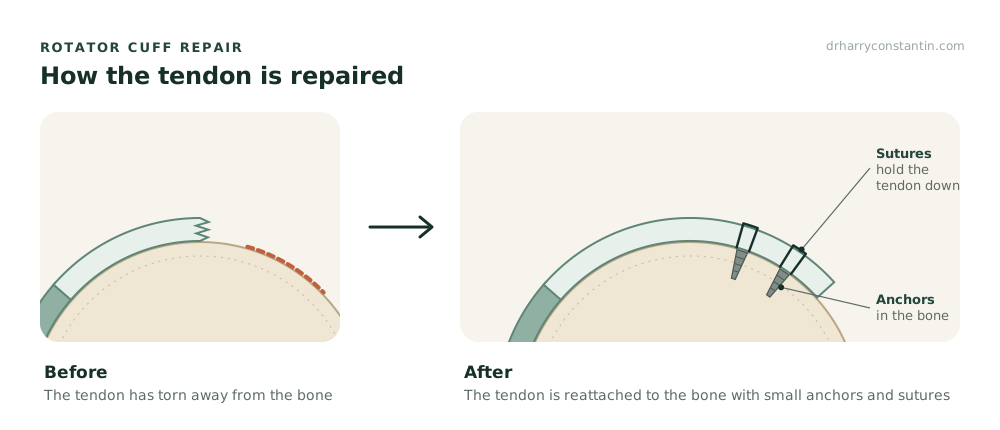
Most rotator cuff repairs are performed arthroscopically (keyhole surgery) through several small incisions. The torn tendon is reattached to the bone using small anchors and sutures. Any bone spurs or calcium deposits can be dealt with in the same operation.
A subscapularis tear is repaired with a technique specific to the front of the shoulder. Because the biceps tendon is often damaged or unstable when the subscapularis is torn, a biceps tenodesis is commonly performed at the same time.
Surgery is usually performed under general anaesthetic with a nerve block for pain relief. Most patients stay overnight and go home the next day.
Recovery and rehabilitation
The repaired tendon needs time to heal back to the bone, so recovery follows a staged program with your physiotherapist. You can download Dr Constantin's Rotator Cuff Repair Rehabilitation Protocol from the Rehab page. Please give a copy to your physiotherapist before your first appointment.
Why following the protocol matters. The first six weeks are the most important time for protecting the repair. Moving the shoulder too much too soon raises the risk of the tendon re-tearing, so sticking closely to the protocol gives you the best chance of a good long-term result. Progress varies with the size of the tear, the quality of the tendon, your age and any other procedures done at the same time. Your physiotherapist and Dr Constantin will adjust the program to suit you.
After a subscapularis repair
Rehabilitation after a subscapularis repair is different from other rotator cuff repairs, and follows Dr Constantin's Subscapularis Repair Rehabilitation Protocol. The sling is worn day and night for six weeks, turning the arm outwards is limited to protect the repair, and strengthening of the subscapularis does not start until 12 weeks. Desk or light work is usually possible from 6–8 weeks.
If you notice sharp pain, increasing swelling or worsening night pain, stop the exercise that caused it and contact your physiotherapist or Dr Constantin's rooms on (02) 9409 0503.
Risks
Rotator cuff repair is a common and generally safe operation. As with any surgery, there are risks, including:
- Shoulder stiffness and frozen shoulder
- Re-tear or failure of the tendon to heal, which is more likely with large tears and in older patients
- Infection
- Nerve or blood vessel injury (rare)
- Anaesthetic complications
Dr Constantin will discuss all risks and expected outcomes prior to your surgery.
Frequently asked questions
Does every rotator cuff tear need surgery?
No. Many rotator cuff problems, particularly partial tears and degenerative tears, improve without surgery, with activity changes, physiotherapy, medication or an injection.
How long will I be in hospital?
Most patients stay overnight and go home the next day.
How long will I wear a sling?
6 weeks, day and night. It can come off for showers and for the exercises in your rehabilitation protocol.
When can I drive?
Usually after 6–8 weeks, once you are out of the sling and can safely control the vehicle. For general advice on driving after surgery, see When can I drive after surgery? in the questions on the home page.
Will I need physiotherapy?
Yes. Recovery follows a staged program with your physiotherapist. Download Dr Constantin's Rotator Cuff Repair Rehabilitation Protocol and give a copy to your physiotherapist before your first appointment.
What is a subscapularis tear?
A tear of the rotator cuff tendon at the front of the shoulder. It often causes pain at the front of the shoulder and difficulty reaching behind your back, and is commonly linked with biceps tendon problems. It needs specific examination tests, as it can be missed on scans.
What is calcific tendinitis?
Calcium deposits that build up within the rotator cuff tendons. The pain can be severe, particularly while the deposit is being reabsorbed. It is most common in people aged 30 to 50.
Is this covered by my health fund, WorkCover or CTP?
Dr Constantin operates at the Mater Hospital, North Sydney, for patients with private health insurance, workers compensation and CTP claims, and at Canterbury Hospital for Medicare-only patients. For costs and cover, see Health insurance & fees or call the rooms to talk through your options.
Book an appointment
If you have shoulder pain or weakness, or a rotator cuff tear on your scan, Dr Constantin can assess the cause and talk you through your options. Please contact Dr Constantin for an assessment, or call (02) 9409 0503.
If you need surgery, it will be performed at the Mater Hospital or Canterbury Hospital.
Related pages
Talk to Dr Constantin about your shoulder
A GP or specialist referral is needed to claim a Medicare rebate. Consultations are available in North Sydney, Kogarah and Miranda.