
The shoulder joint and arthritis
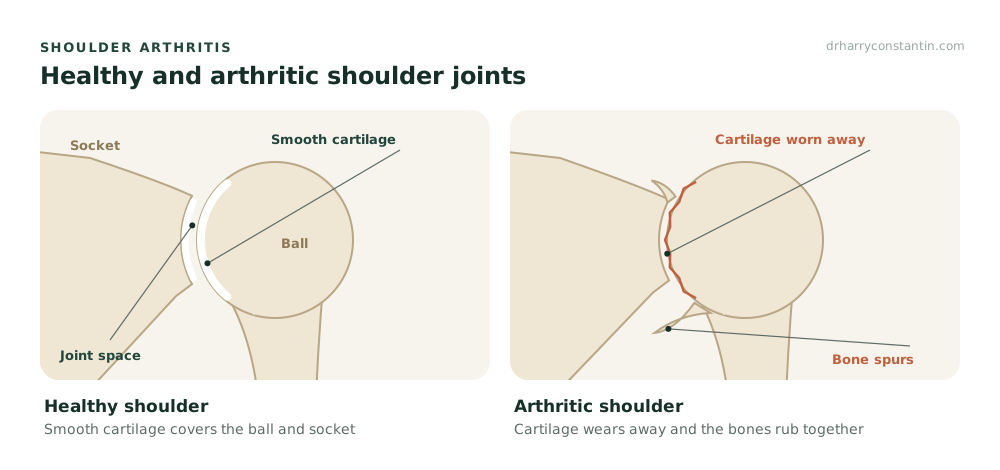
The shoulder is a ball-and-socket joint. The ball is the top of the arm bone (the humeral head) and the socket is a shallow cup on the shoulder blade (the glenoid). Both are covered in smooth cartilage, and the joint is powered and stabilised by the muscles and tendons of the rotator cuff.
When the cartilage wears away through arthritis, or the rotator cuff fails, the shoulder can become painful, stiff and weak. Shoulder replacement (shoulder arthroplasty) replaces the damaged joint surfaces with an implant to relieve pain and improve function. Dr Constantin performs anatomic and reverse total shoulder replacement and pyrocarbon hemiarthroplasty, tailored to each patient's anatomy, age and goals.
Dr Constantin has a particular interest in shoulder replacement, including complex and revision shoulder replacement. He completed his Shoulder Fellowship at the Institut de Chirurgie Réparatrice (ICR) in Nice, France, with Professor Pascal Boileau, where he gained advanced experience in primary and revision shoulder replacement.
When is a shoulder replacement needed?
A shoulder replacement may be recommended for:
- Osteoarthritis: wear-and-tear loss of the joint cartilage
- Rotator cuff arthropathy: arthritis that develops after a large, long-standing rotator cuff tear
- Massive, irreparable rotator cuff tears, even without significant arthritis
- Inflammatory arthritis, such as rheumatoid arthritis
- Avascular necrosis: loss of blood supply to the humeral head causing it to collapse
- Complex fractures of the shoulder (proximal humerus), particularly in older patients
- Arthritis after previous injury, dislocation or surgery, including failed previous shoulder replacement
Symptoms
- Deep, aching shoulder pain, often worse at night and disturbing sleep
- Stiffness and loss of movement, with difficulty reaching overhead, behind your back or to wash your hair
- Weakness, or being unable to lift the arm (pseudoparalysis) when the rotator cuff has failed
- Grinding, clicking or catching in the joint
- Difficulty with everyday tasks such as dressing, driving and lifting
Diagnosis
At your consultation Dr Constantin will discuss your symptoms and how they affect your life, and examine the shoulder's movement, strength and rotator cuff function.
X-rays show the degree of arthritis. A CT scan is commonly used to assess the shape and bone stock of the socket and to plan the surgery, and an MRI or ultrasound may be used to assess the rotator cuff.
Non-surgical treatment
Shoulder replacement is considered when non-surgical treatment no longer controls your symptoms. Non-surgical options include:
- Activity modification and simple pain relief
- Physiotherapy to maintain movement and strengthen the surrounding muscles
- Image-guided injections, such as corticosteroid injections, for temporary relief
Surgery is recommended when pain, stiffness or weakness significantly affects your sleep, work or quality of life despite these measures.
Types of shoulder replacement
Reverse total shoulder replacement
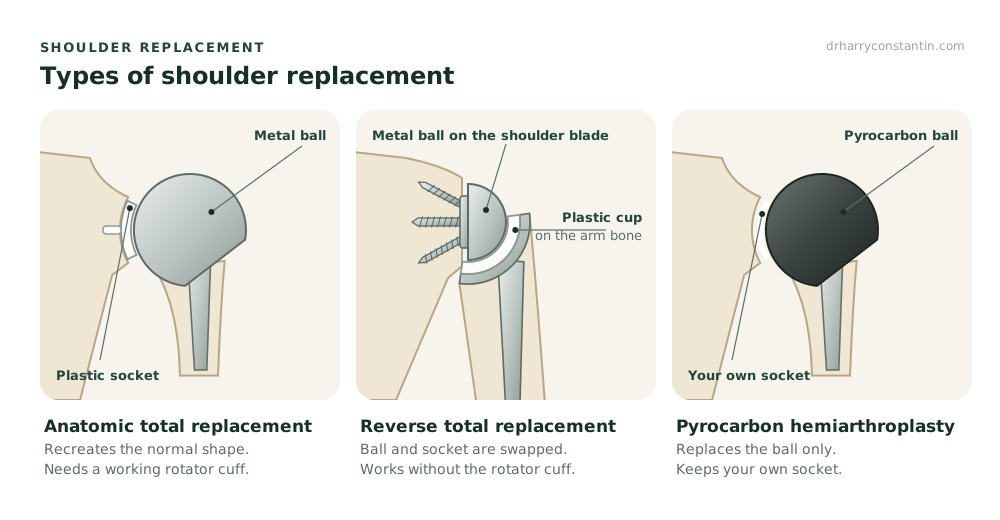
In a reverse shoulder replacement the normal ball-and-socket arrangement is reversed: a metal ball is fixed to the shoulder blade and a plastic-lined socket is fixed to the top of the arm bone. This changes the mechanics of the shoulder so that the deltoid muscle can lift the arm without relying on the rotator cuff.
Reverse replacement is the procedure of choice when the rotator cuff is torn or not working, including rotator cuff arthropathy, massive irreparable cuff tears and complex fractures in older patients. It is also increasingly used for arthritis in older patients with an intact cuff, and for severe wear of the socket. It aims to relieve pain and restore the ability to lift the arm. Regaining internal rotation to the level you had before, such as reaching behind your back, is difficult after a reverse replacement, but it is possible.
Anatomic total shoulder replacement
An anatomic total shoulder replacement recreates the normal shape of the shoulder. The worn humeral head is replaced with a smooth metal ball, and the arthritic socket is resurfaced with a durable, high-density polyethylene (plastic) component. Because the implant restores the shoulder's natural anatomy, it relies on a healthy, functioning rotator cuff to move and stabilise the joint.
Anatomic replacement is the preferred option for patients with osteoarthritis or inflammatory arthritis who have an intact rotator cuff and enough bone in the socket to support the implant. It aims to relieve pain and give a natural-feeling shoulder, and many patients return to everyday activities, golf, swimming and light gym work. As the plastic socket can wear or loosen over many years, heavy lifting and high-impact activities are best avoided to protect the joint long term.
Pyrocarbon hemiarthroplasty
A hemiarthroplasty replaces only the ball (humeral head), leaving the patient's own socket in place. Pyrocarbon is an advanced carbon material with an elasticity close to that of bone and a very smooth, low-friction surface. As a result, it causes significantly less wear of the natural socket than traditional metal implants, and there is no plastic component to wear or loosen.
Pyrocarbon hemiarthroplasty is designed for younger, active patients with arthritis whose rotator cuff is intact. By preserving the patient's own glenoid it keeps future options open, and it avoids the activity restrictions associated with a plastic socket, which can wear out with overuse, or with a reverse shoulder replacement.
The surgery
Shoulder replacement is performed under a general anaesthetic, usually combined with a nerve block (interscalene block) that keeps the shoulder comfortable for the first day. Surgery is performed through an incision at the front of the shoulder. The subscapularis tendon at the front of the joint is carefully released to access the joint and then securely repaired at the end of the operation.
The worn joint surfaces are removed and the implants are fixed to the bone. Dr Constantin uses detailed CT-based planning before surgery to select implant size and position for each patient. Most patients stay in hospital for one night.
Risks and complications
Shoulder replacement is a well-established operation, but as with all surgery there are risks. These will be discussed with you in detail before surgery and include:
- Infection (uncommon, around 1%)
- Fracture of the arm bone or shoulder blade during or after surgery, including stress fracture of the acromion after reverse replacement
- Failure of the subscapularis tendon repair
- Stiffness or persistent pain
- Dislocation or instability of the implant
- Nerve injury
- Wear or loosening of the implant over time, or wear of the natural socket after hemiarthroplasty, which may require revision surgery
- Blood clots and anaesthetic complications (rare)
Recovery and rehabilitation
Rehabilitation follows Dr Constantin's protocols and is supervised by your physiotherapist. Your rehabilitation will be individualised, and your progress will be reviewed at each follow-up appointment. Use ice packs regularly to help control swelling, and keep the wound dry for two weeks.
The full protocols are available on the Rehabilitation page for you and your physiotherapist.
Returning to everyday activities
- Driving: not while in a sling; usually 8–12 weeks after pyrocarbon hemiarthroplasty, depending on rehabilitation and pain control
- Desk work: at least 6 weeks off
- Heavy manual work: around 6 months off
- Sport: golf ~12 weeks; swimming – breaststroke ~5 weeks (reverse), freestyle ~12 weeks; contact sport 4–6 months after reverse replacement
Most improvement occurs in the first six months, but the shoulder continues to improve for 12–24 months after surgery. Long-term shoulder strengthening and control exercises help protect your new joint.
Frequently asked questions
How long does a shoulder replacement last?
Modern shoulder replacements are durable. Data from the Australian Orthopaedic Association National Joint Replacement Registry show a revision rate of approximately 5% at 10 years for reverse shoulder replacements, so around 95% have not needed further surgery 10 years after the operation. Revision rates for anatomic replacements are slightly higher. Many shoulder replacements last considerably longer. Your individual expectations will depend on your age, activity level and the type of implant.
Which type of shoulder replacement is right for me?
It depends mainly on the health of your rotator cuff, the condition of the socket (glenoid), your age and your activity goals. A reverse replacement is usually recommended when the rotator cuff is torn or not working, and in older patients. An anatomic replacement may suit patients with arthritis whose rotator cuff is healthy. A pyrocarbon hemiarthroplasty may suit younger, more active patients with arthritis whose rotator cuff is intact. Dr Constantin will explain which option suits you after reviewing your scans.
How long will I be in hospital?
Most patients stay in hospital for one night.
How long will I wear a sling?
Usually four to six weeks, to protect the subscapularis tendon repair. Your rehabilitation protocol explains when to wean out of the sling.
When can I drive?
Not while you are wearing a sling. After a pyrocarbon hemiarthroplasty, driving is usually not possible for 8–12 weeks, depending on your rehabilitation and pain control. Check with your insurer before returning to driving. For general advice, see When can I drive after surgery? in the questions on the home page.
When can I return to work?
Desk-based work usually requires at least six weeks off. Heavy manual work usually requires around six months off. This will be tailored to you and your job.
Can I play golf and swim after a shoulder replacement?
Yes. Golf is generally possible from around 12 weeks, and freestyle swimming from around 12 weeks. Breaststroke can start earlier, from around five weeks after a reverse replacement. Contact sports are generally possible from four to six months after a reverse replacement.
Can I lift weights after a shoulder replacement?
Most patients return to light gym work. Heavy overhead lifting should be avoided unless cleared by Dr Constantin. After a pyrocarbon hemiarthroplasty, pushing exercises such as bench press and shoulder press should be avoided, and weight training is limited to closed-chain exercises.
Is a shoulder replacement covered by my health fund, WorkCover or CTP?
Dr Constantin operates at the Mater Hospital, North Sydney, for patients with private health insurance, workers compensation and CTP claims, and at Canterbury Hospital for Medicare-only patients. For costs and cover, see Health insurance & fees or call the rooms to talk through your options.
Book an appointment
If shoulder pain, stiffness or weakness is affecting your sleep, work or lifestyle, Dr Constantin can assess whether a shoulder replacement or another treatment is right for you. Please contact Dr Constantin for an assessment, or call (02) 9409 0503.
If you need surgery, it will be performed at the Mater Hospital or Canterbury Hospital.
Related pages
The information on this page is general in nature and is not a substitute for individual medical advice. Recovery timeframes are a guide only and will be tailored to you.
Talk to Dr Constantin about your shoulder
A GP or specialist referral is needed to claim a Medicare rebate. Consultations are available in North Sydney, Kogarah and Miranda.