
What is a clavicle fracture?
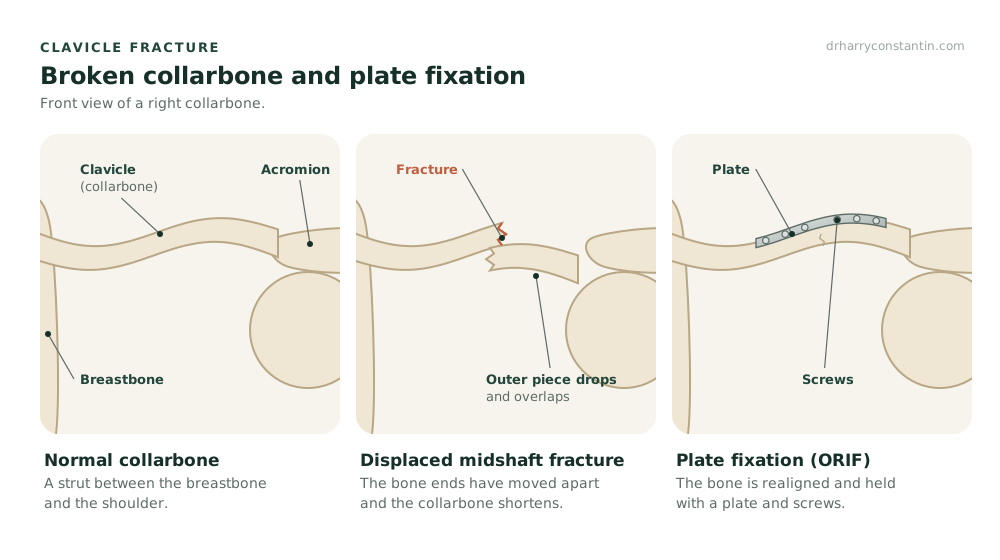
The clavicle, or collarbone, is the long, S-shaped bone that runs across the top of the chest from the breastbone (sternum) to the shoulder blade. It acts as a strut that holds the shoulder out to the side and connects the arm to the rest of the skeleton.
A clavicle fracture is a break in this bone. It is one of the most common fractures, particularly in active people and those who play sport. Most clavicle fractures heal well without an operation. Some need surgery to avoid the bone not healing or healing in a poor position.
Common causes
- A fall onto the shoulder or a direct blow. The most common cause, often during cycling, mountain biking, horse riding, skiing or snowboarding.
- Contact sport. Tackles and collisions in rugby, AFL, soccer and martial arts.
- High-speed sport and road accidents. Motor racing, motorbike and car accidents, which can cause more complex fractures.
- A fall onto an outstretched arm. Force travels up the arm to the collarbone.
Most clavicle fractures happen on their own, but they can occur with other injuries, such as rib fractures or other fractures around the shoulder.
Types of clavicle fracture
- Midshaft fractures. A break in the middle third of the collarbone, accounting for most clavicle fractures.
- Distal (lateral) fractures. A break at the outer end of the collarbone, near the AC joint. These are unstable if the coracoclavicular (CC) ligaments that hold the collarbone down are also torn, and then behave more like an AC joint dislocation. See AC joint injury.
- Medial fractures. A break at the inner end near the breastbone. These are uncommon and usually follow high-energy injuries.
Fractures are also described by how far the bone ends have moved apart (displacement), whether the bone is broken into several pieces (comminuted), and whether the collarbone has shortened.
Symptoms
- Pain over the collarbone straight after a fall or impact, sometimes with a crack felt at the time
- Swelling, bruising and tenderness over the collarbone
- A bump or deformity where the bone has broken
- Difficulty lifting the arm because of pain, and holding it close to the body for comfort
- A clicking or grinding sensation when moving the shoulder
- A drooping, forward-sloping shoulder
Seek urgent medical attention, or call 000 in an emergency, if you are short of breath or feel faint or very unwell, if the skin over the fracture is broken or the bone is pushing against it, or if you have new numbness, tingling, weakness or coldness in the arm or hand.
Assessment
Your consultation includes a history of the injury and your symptoms, and an examination of the collarbone, the skin over the fracture, and the nerves and circulation of the arm. X-rays show the type of fracture, how much the bone has moved and whether it has shortened. X-rays are best taken with you sitting or standing, as they can show more of the displacement than X-rays taken lying down. A CT scan is sometimes used for complex fractures, or those near the joints at either end of the collarbone, to help plan surgery.
Non-surgical treatment
Many clavicle fractures, particularly those where the bone ends have not moved much, heal well without surgery:
- A simple sling to support the arm and ease pain, usually for six weeks. You will come out of the sling to do your exercises. A figure-of-eight brace offers no advantage
- Pain relief, and ice packs for pain and swelling
- Sleeping propped up on pillows, as the first few nights are usually the most uncomfortable
- Early gentle movement of the elbow, wrist and hand, then the shoulder once the fracture starts to heal
- Follow-up X-rays to make sure the fracture is healing in a good position
- Physiotherapy to prevent stiffness and restore movement and strength. Heavier resistance and strength training is put on hold until the bone has healed enough to take the load, usually around three months
- If you smoke, stopping gives the bone the best chance of healing
Most fractures heal in six to twelve weeks, and children's fractures heal faster. It is normal for a firm lump to form where the bone has healed. Undisplaced fractures at the outer end of the collarbone are also usually treated in a sling for six weeks, although full healing can take up to three months.
It was once thought that almost every broken collarbone would heal well in a sling. This is true for children, but adults with displaced fractures are more likely to have a fracture that does not heal, a shortened collarbone, or a shoulder that never feels quite right.
When is surgery recommended?
Surgery may be recommended when:
- The bone ends have moved out of place (displaced), are overlapping, or the collarbone has shortened significantly
- The bone is broken into several pieces
- The bone has broken through the skin (a compound or open fracture), or is pushing against it
- There is injury to nearby nerves or blood vessels
- The fracture is at the outer end of the collarbone and the CC ligaments are torn, so the collarbone has displaced upwards. These have a high risk of not healing
- There are other fractures, including other injuries to the same shoulder
- The fracture has not healed (a non-union), or has healed in a poor position and is causing symptoms
- You are an athlete or manual worker and want a faster, more predictable return to sport or work
Displaced fractures treated without surgery have a higher risk of not healing and can leave the shoulder weaker or with a noticeable deformity. Fixing the fracture realigns the bone, holds it stable while it heals, reduces the risk of non-union and allows earlier movement.
What does the research show?
Over the past 20 years, large clinical trials have compared surgery with a sling for adults whose collarbone has broken right through and moved out of place. In summary:
- Healing. Without surgery, about 1 in 7 of these fractures do not heal. With a plate and screws, around 1 in 50 or fewer do not heal.
- Healing in a poor position. Without surgery, the bone often heals shorter and lower than before. About 1 in 9 people are then troubled by weakness, tiring quickly with the arm overhead, aching, or a drooping shoulder. This is most likely when the collarbone has shortened by about 2 cm or more. It can be corrected later, but that is a bigger operation than fixing the fracture at the start.
- Recovery. Surgery usually means less pain early on and a quicker return to work and sport. By six to twelve months, most people do equally well either way, as long as the bone heals.
- The trade-offs of surgery. Numbness of the skin below the scar is common. About 1 in 10 people have the plate removed later because it is prominent or irritating, and a small number develop a wound infection, which is usually minor.
- Smoking. Smokers are several times more likely to have a fracture that does not heal, with or without surgery.
- Teenagers. Most teenagers heal well without surgery, even when the break has moved, and surgery has not been shown to improve their long-term function.
- Fractures at the outer end. Research is still limited. What matters most is whether the coracoclavicular (CC) ligaments, which hold the collarbone down to the shoulder blade, are intact. If they are, the fracture is usually stable and heals well without surgery. If they are torn, the collarbone is pulled upwards and the injury behaves more like an AC joint dislocation (separation), so it is assessed and treated in a similar way. After surgery, the plate often needs to be removed later.
Surgery is often a good option if the bone ends have moved completely apart or overlap, the bone is in several pieces or has shortened, you smoke, or you are active and want to get back to work or sport sooner. Age alone is not a reason for or against surgery. Dr Constantin will talk you through the options so you can decide together what suits you best.
Ultrasound bone stimulators do not speed up healing of a fresh collarbone fracture, so they are not recommended.
Clavicle fracture surgery (plate fixation)
The most common operation is an open reduction and internal fixation (ORIF). Through an incision along the collarbone, the broken pieces are realigned and held in place with an anatomical plate and screws. When the bone is in several pieces, extra screws may be used, and bone from around the fracture can be used to help it heal. Some fractures can instead be held with a pin or nail inside the bone. X-rays are taken during the operation to check the position, and the skin is closed with dissolving stitches.
For fractures at the outer end of the collarbone, a hook plate is sometimes used. The plate is fixed to the collarbone, and its hook sits under the acromion (the bony tip of the shoulder) to hold the collarbone down while the bone and ligaments heal. Because the hook sits under the acromion, the plate is usually removed once the fracture has healed (around 3 months). Some outer-end fractures can instead be fixed with a smaller locking plate, sometimes with strong sutures to hold the collarbone down to the coracoid.
Surgery is performed under general anaesthetic. Most patients go home the same day or the next day. Pain usually settles quickly once the fracture is held still. The plate usually stays in permanently, but it can be removed once the bone has fully healed if it becomes prominent or irritating, for example under a backpack strap.
Recovery and rehabilitation
Recovery follows a staged program with your physiotherapist, and your progress is checked with X-rays at your follow-up appointments. In general, after surgery:
- Weeks 0–6: a sling for six weeks, especially in crowded places to avoid being bumped. You come out of the sling to do your exercises: elbow, wrist and hand movement, and gentle shoulder movement, with assisted movement limited to 90°. No lifting, reaching above shoulder height or reaching behind your back.
- Weeks 6–12: once X-rays start to show healing, the sling comes off and full range of motion is permitted. Light everyday use of the arm. Heavier resistance and strength training waits until the bone has healed enough, usually around three months.
- 3 months +: strength training, contact sport and heavy manual work resume once the bone has healed and strength has returned.
Risks
Clavicle fracture surgery is common and generally safe. As with any surgery, there are risks, including:
- Numbness of the skin below the incision, which usually improves over time
- A prominent or irritating plate that may need removal after the bone has healed
- Infection or wound problems
- The fracture not healing, or the plate or screws loosening
- Injury to nearby nerves or blood vessels (rare)
Dr Constantin will discuss all risks and expected outcomes prior to your surgery.
Frequently asked questions
Does a broken collarbone need surgery?
Not always. Many clavicle fractures heal well in a sling. Surgery is usually recommended when the bone ends are displaced, overlapping or in several pieces, when the skin is broken or threatened, or for athletes and manual workers who need a faster, more reliable recovery.
My teenager has broken their collarbone. Do they need surgery?
Usually not. Most teenagers heal well in a sling, even when the break has moved, and studies have not shown better long-term function after surgery. Surgery is kept for open fractures, threatened skin, nerve or blood vessel injury, and some older teenagers with severely displaced fractures.
How long does a broken collarbone take to heal?
Most clavicle fractures heal in six to twelve weeks, whether or not surgery is needed. Some take longer, and full strength and return to contact sport usually take around three months.
How long will I be in a sling?
Usually six weeks, whether or not you have surgery. You will come out of the sling to do your exercises.
When can I drive?
Not while you're wearing a sling. Most people can drive again once the sling is off and they can move the arm comfortably and control the car safely, usually from around six weeks.
When can I return to work?
Desk work can often resume within one to two weeks, in the sling. Light manual work can usually resume once the sling comes off at around six weeks, and heavy manual and overhead work at around three months, depending on healing.
When can I get back on the bike?
Riding on an indoor trainer can usually start once you are out of the sling at around six weeks. Riding outdoors, where there is a risk of falling, should wait until the bone has healed, usually around six to twelve weeks. Contact sport usually resumes from about three months.
Will the plate need to come out?
Most people keep the plate permanently without any problems. If it becomes prominent or uncomfortable, it can be removed once the fracture has fully healed, usually after at least a year.
I was injured in a car or motorbike accident. Can you treat me under CTP?
Yes. Dr Constantin treats CTP and workers compensation patients at the Mater Hospital, North Sydney.
Is this covered by my health fund, WorkCover or CTP?
Dr Constantin operates at the Mater Hospital, North Sydney, for patients with private health insurance, workers compensation and CTP claims, and at Canterbury Hospital for Medicare-only patients. For costs and cover, see Health insurance & fees or call the rooms to talk through your options.
Do I need a referral?
Yes. You'll need a referral from your GP or another specialist to see Dr Constantin. See Referrals.
Book an appointment
Clavicle fractures are best assessed early, ideally within the first week or two after injury. Please contact Dr Constantin for an assessment, or call (02) 9409 0503.
If you need surgery, it will be performed at the Mater Hospital or Canterbury Hospital.
Related pages
The information on this page is general in nature and is not a substitute for individual medical advice. Recovery timeframes are a guide only and will be tailored to you.
Talk to Dr Constantin about your shoulder
A GP or specialist referral is needed to claim a Medicare rebate. Consultations are available in North Sydney, Kogarah and Miranda.