
What is shoulder instability?
The shoulder is a ball-and-socket joint, but it is not like the hip, where the ball sits deep in a very congruent socket. The shoulder is more like an egg on a plate, or a golf ball on a tee. This is what gives the shoulder its great range of motion, but it is also why shoulders are prone to dislocate.
The ball (humeral head) sits in a shallow socket (glenoid), held in place by a rim of cartilage called the labrum, the joint capsule and ligaments, and the rotator cuff muscles. When these structures are stretched or torn, the ball can slip partly out of the socket (a subluxation) or come out completely (a dislocation).
Once the shoulder has dislocated, it is more likely to happen again, particularly in young and active people. Repeated episodes of the shoulder slipping or dislocating are known as shoulder instability.
Types of shoulder instability
- Anterior (forward) instability. The most common type, accounting for most dislocations. It usually happens when the arm is forced out to the side and backwards, such as in a tackle or a fall.
- Posterior (backward) instability. Less common. It can follow a fall onto an outstretched arm, a seizure or an electric shock, and is common in weightlifters and contact sport players. See Posterior shoulder instability.
- Multidirectional instability. The shoulder is loose in several directions, usually due to naturally lax ligaments rather than a single injury.
Common injuries with a dislocation
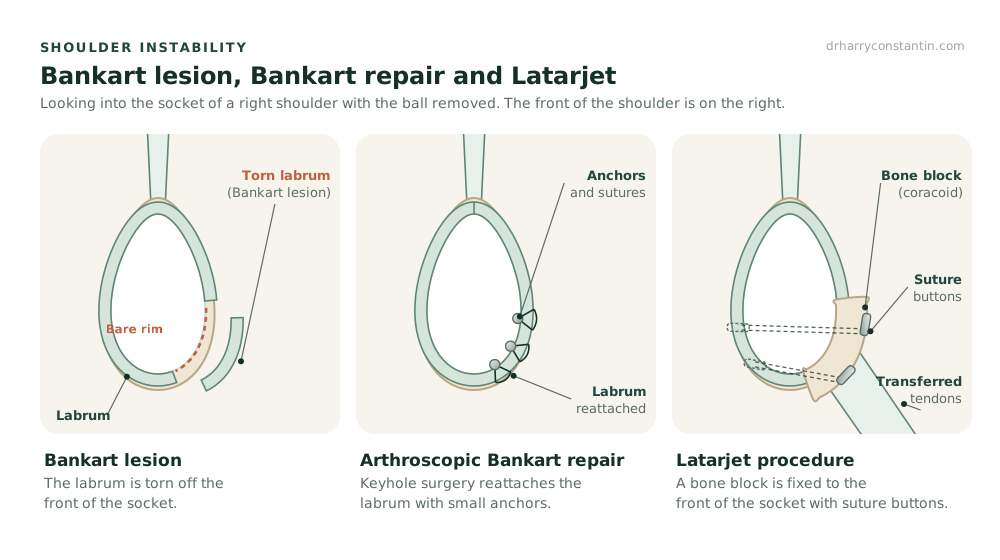
- Bankart lesion. The labrum and its attached ligaments are torn away from the front of the socket. This is the most common injury after an anterior dislocation.
- Bone loss. A piece of the socket rim can be broken off or worn away with repeated dislocations (a bony Bankart or glenoid bone loss).
- Hill-Sachs lesion. A dent in the back of the ball, caused when it impacts against the rim of the socket during a dislocation.
- Associated injuries. Rotator cuff tears, particularly in people over 40, and nerve injury, most commonly to the axillary nerve.
Symptoms
- The shoulder slipping, popping out or feeling loose
- Apprehension or fear that the shoulder will dislocate in certain positions, such as reaching overhead or throwing
- Pain, particularly after an episode of instability
- Weakness, or a dead-arm feeling
- Numbness or tingling down the arm
- Avoiding sport or activities because the shoulder can't be trusted
Assessment
Your consultation includes a detailed history of how and how often the shoulder has dislocated, and an examination of stability, range of movement, strength and nerve function.
Imaging usually includes X-rays, an MRI to assess the labrum and ligaments, and a CT scan to measure any bone loss from the socket or ball. The amount of bone loss is one of the most important factors in choosing between a Bankart repair and a Latarjet procedure.
Non-surgical treatment
After a first dislocation, many people are treated without surgery, particularly those who are older or less active:
- A short period in a sling for comfort
- Pain relief and anti-inflammatory medication
- A structured physiotherapy program to restore movement and strengthen the rotator cuff and shoulder blade muscles
- Gradual return to activity, avoiding high-risk positions early on
Non-surgical treatment is also the main treatment for multidirectional instability.
When is surgery recommended?
Surgery may be recommended when:
- The shoulder has dislocated more than once, or continues to feel unstable despite physiotherapy
- You are young and play contact, collision or overhead sport, where the risk of dislocating again after a first dislocation is high
- There is significant bone loss from the socket or ball
- There is an associated injury, such as a rotator cuff tear, that needs repair
- Your work or sport requires a stable shoulder
Arthroscopic Bankart repair
A Bankart repair reattaches the torn labrum and ligaments to the front of the socket, restoring the shoulder's natural stabilising structures. It is performed arthroscopically (keyhole surgery) through several small incisions. Small anchors are placed in the rim of the socket and sutures are used to repair the labrum and tighten the stretched capsule.
A Bankart repair is best suited to patients with little or no bone loss. Most patients go home the same day or the next day.
Latarjet procedure
The Latarjet procedure is used when there is significant bone loss from the socket, when a previous stabilisation has failed, or in high-risk contact and collision athletes. A small piece of bone (the coracoid process), with its attached tendons, is transferred to the front of the socket and fixed in place.
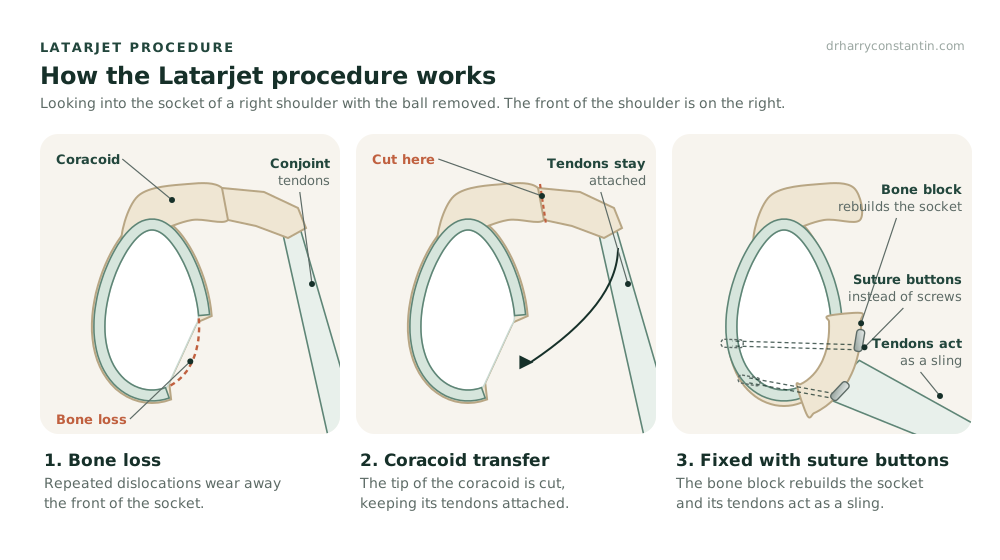
This stabilises the shoulder in three ways: it enlarges the socket, the transferred tendons act as a sling across the front of the joint when the arm is raised and rotated, and the capsule is repaired. The Latarjet has a low rate of recurrent dislocation, and is performed as an open procedure through a small incision at the front of the shoulder. Most patients stay in hospital for one night.
Dr Constantin performs the Latarjet using suture buttons (the Advanced Glenoid Bone Loss system from Smith & Nephew) rather than screws to hold the bone block in place. Around 10% of patients may have problems with screws, such as screws becoming prominent or irritating and needing to be removed. Suture buttons avoid these problems.
Choosing the right operation for you
Dr Constantin keeps up to date with the research on shoulder instability, and recommends an operation based on your goals: the sport you play and the level you play at, your work, how loose your joints are (hyperlaxity), the amount of bone loss, and how many times the shoulder has dislocated.
Many Australians lead a very active lifestyle. The evidence shows that the Latarjet has a lower rate of the shoulder dislocating again, a lower rate of needing further surgery, and a better return to the previous level of sport than a keyhole Bankart repair, particularly in young people who play contact, collision or overhead sport. For this reason, more often than not, the Latarjet is the more robust operation for active patients. For others, a Bankart repair may be the better choice.
Dr Constantin completed his Shoulder Fellowship at the Institut de Chirurgie Réparatrice (ICR) in Nice, France, with Professor Pascal Boileau, where his training included instability surgery and, in particular, the Latarjet procedure using suture buttons. He will take you through your options so that the operation matches your goals.
Recovery and rehabilitation
Recovery follows a staged program with your physiotherapist, protecting the repair while it heals and then gradually restoring movement and strength. Early on, external rotation (turning the arm outwards) is limited to protect the repair. The full Latarjet protocol is available on the Rehabilitation page. Please give a copy to your physiotherapist before your first appointment.
After a Latarjet
The sling is worn full time for four weeks, including at night. External rotation is limited and increased in stages over the first eight weeks, strength training can start from 12 weeks, and return to sport is usually from three months, once full movement and strength have been restored and Dr Constantin has approved it.
After an anterior Bankart repair
Rehabilitation follows a similar staged approach, with a sling for around four to six weeks and a longer period before returning to contact and overhead sport, usually around six months. Your physiotherapist will be given a protocol tailored to your surgery.
Risks
Shoulder stabilisation surgery is common and generally safe. As with any surgery, there are risks, including:
- Recurrent dislocation or instability
- Stiffness, particularly loss of external rotation
- Infection
- Nerve or blood vessel injury (rare)
- Anaesthetic complications
Dr Constantin will discuss all risks and expected outcomes prior to your surgery.
Frequently asked questions
Will my shoulder dislocate again?
It depends mainly on your age and activity level. Young people who play contact or overhead sport have a high chance of dislocating again after a first dislocation, while the risk is much lower in older and less active people.
What is the difference between a Bankart repair and a Latarjet?
A Bankart repair is keyhole surgery that reattaches the torn labrum and ligaments. A Latarjet transfers a small piece of bone to the front of the socket, where Dr Constantin fixes it with suture buttons rather than screws. It is recommended when there is bone loss, when a previous repair has failed, or for high-risk contact athletes.
Which operation is right for me?
It depends on your goals, your sport and work, how loose your joints are, the amount of bone loss and how many times the shoulder has dislocated. For many active people, particularly those who play contact, collision or overhead sport, the evidence shows the Latarjet has a lower rate of dislocating again than a Bankart repair. Dr Constantin will talk you through the options so the operation matches your goals.
How long will I be in a sling?
After a Latarjet, four weeks full time, including at night. After a Bankart repair, usually four to six weeks.
When can I drive?
Not while you're in the sling. Most people can drive again once the sling is off and they have enough movement and control. For general advice, see When can I drive after surgery? in the questions on the home page.
When can I return to work?
Computer and desk work can usually resume once pain is controlled, often within one to two weeks. Manual and overhead work takes longer and is guided by your progress.
When can I return to sport?
After a Latarjet, return to sport is usually from three months, once full movement and strength have been restored and Dr Constantin has approved it. After a Bankart repair, return to contact and overhead sport is usually around six months.
Is this covered by my health fund, WorkCover or CTP?
Dr Constantin operates at the Mater Hospital, North Sydney, for patients with private health insurance, workers compensation and CTP claims, and at Canterbury Hospital for Medicare-only patients. For costs and cover, see Health insurance & fees or call the rooms to talk through your options.
Do I need a referral?
Yes. You'll need a referral from your GP or another specialist to see Dr Constantin. See Referrals.
Book an appointment
If your shoulder has dislocated or feels unstable, Dr Constantin can assess the cause and talk you through your options. Please contact Dr Constantin for an assessment, or call (02) 9409 0503.
If you need surgery, it will be performed at the Mater Hospital or Canterbury Hospital.
Related pages
The information on this page is general in nature and is not a substitute for individual medical advice. Recovery timeframes are a guide only and will be tailored to you.
Talk to Dr Constantin about your shoulder
A GP or specialist referral is needed to claim a Medicare rebate. Consultations are available in North Sydney, Kogarah and Miranda.