
Timing matters. If you think you have torn your distal biceps tendon, please call (02) 9409 0503 for an urgent appointment. Repair is most reliable when performed within the first two weeks after the injury.
What is a distal biceps rupture?
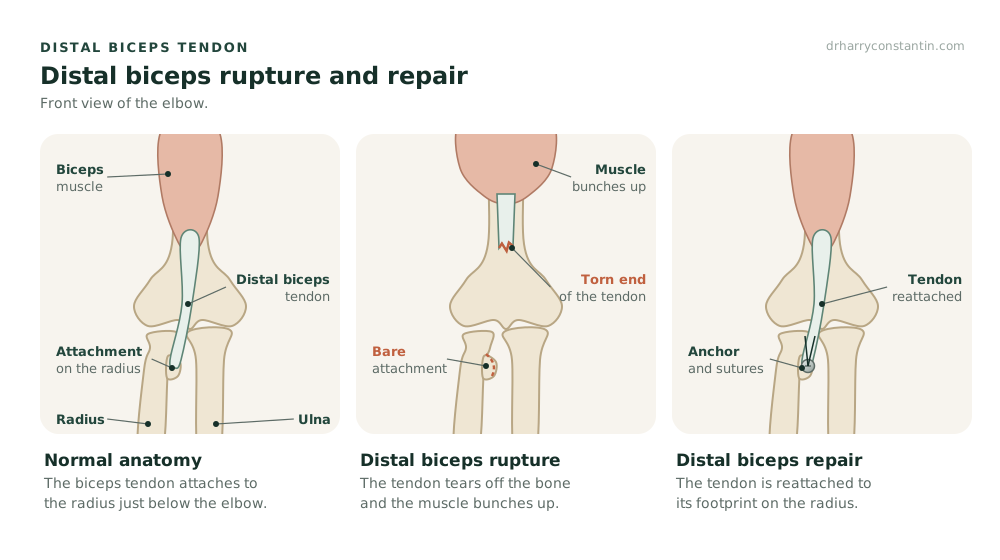
The biceps muscle attaches to the forearm just below the elbow through the distal biceps tendon. This tendon is essential for bending the elbow and, even more importantly, for rotating the forearm to turn the palm upwards (supination). This is the movement you use to turn a key, a screwdriver or a door handle.
A distal biceps rupture occurs when this tendon tears away from its attachment on the radius bone (the radial tuberosity). Once torn, the tendon retracts up the arm and cannot heal back to the bone on its own.
Who gets a distal biceps rupture?
Distal biceps ruptures most commonly affect men between 40 and 60 years of age, usually in the dominant arm. Risk is higher in:
- Manual workers. Builders, tradespeople, labourers, removalists and others who lift and carry heavy loads. Many ruptures happen at work.
- Bodybuilders and gym-goers, particularly with heavy preacher curls, barbell curls and rows, and the underhand arm in a mixed-grip deadlift.
- People who use anabolic steroids
- Smokers
- People who are overweight
- People with pre-existing wear (degeneration) of the tendon
How does it happen?
Most ruptures happen during an eccentric contraction. This is when the biceps is working hard to bend the elbow, but a heavy load forces the elbow straight, so the muscle is lengthening as it pulls. The tendon cannot take the force and pulls off the bone.
At work, this is typically catching or taking the weight of a heavy object, such as a falling sheet of material, a load that slips, or a heavy item when a co-worker lets go. In the gym, the classic example is lowering a heavy weight at the bottom of a preacher curl, or the underhand arm during a heavy mixed-grip deadlift.
The middle part of the tendon has a relatively poor blood supply, which is one reason it can weaken with age, smoking and steroid use before it tears.
Symptoms
- A sudden "pop" at the front of the elbow at the time of injury
- Pain and swelling at the front of the elbow
- Bruising at the elbow and forearm, appearing over the following days
- A change in the shape of the arm, as the biceps muscle bunches up towards the shoulder (the "reverse Popeye" sign)
- Weakness bending the elbow and, especially, turning the palm up
- Cramping or fatigue in the arm with repetitive tasks
Pain often settles within a few weeks, which can give a false sense that the injury has healed. The weakness, however, persists.
Diagnosis
At your consultation Dr Constantin will discuss how the injury occurred and examine the elbow for bruising, tenderness, the shape of the biceps and your strength. Specific clinical tests, such as the hook test, help detect a complete rupture.
An ultrasound or MRI scan is commonly used to confirm the diagnosis, determine whether the tear is partial or complete, and assess how far the tendon has retracted. This information helps plan the most appropriate treatment.
Injured at work?
Distal biceps ruptures are a common workplace injury in manual workers. Dr Constantin treats workers compensation patients and performs their surgery at the Mater Hospital, North Sydney, or Canterbury Hospital.
Because repair is most reliable in the first two weeks, report the injury to your employer and lodge your claim straight away, and bring your claim number to your appointment. You will need a referral from your GP. Many people can return to light, one-handed duties within one to two weeks, while heavy manual work usually takes three to six months.
Treatment options
Non-surgical treatment
Non-surgical treatment may be appropriate for people who are less active, have significant medical conditions that make surgery higher risk, or who prefer to avoid surgery. It involves rest, pain relief and physiotherapy. Most people regain reasonable function for everyday tasks. Studies show an average permanent loss of around a third of supination (palm-up turning) strength and endurance, and around 30% of elbow bending strength, although some people do not notice this loss in daily life. What you can expect is a change in the shape (contour) of the arm, which does not get worse over time, and some cramping in the biceps, particularly with repetitive tasks.
Surgical repair
For active people, manual workers, bodybuilders and anyone who relies on arm strength, surgical repair is generally recommended to restore strength, endurance and the normal shape of the arm.
What does the research show?
A 2022 review of 62 studies, including nearly 2,500 patients, compared surgical repair with non-surgical treatment of complete distal biceps ruptures (Looney et al., Journal of Shoulder and Elbow Surgery). In summary:
- Strength. After repair, elbow bending strength recovered to around 96% of the other arm, compared with about 70% without surgery. Supination strength recovered to around 91%, compared with about 64% without surgery.
- Endurance. Supination endurance, which matters for repetitive work such as using tools, recovered to around 97% after repair, compared with about 63% without surgery.
- Function. People who had surgery scored in the normal range on arm function questionnaires, while those treated without surgery were left with some ongoing disability.
- Complications after surgery. The most common were temporary numbness of the outer forearm (about 1 in 10) and extra bone formation around the repair (about 1 in 9), which occasionally limits forearm rotation. Re-rupture (fewer than 1 in 100), infection (about 1 in 100) and injury to the main motor nerve (very rare) were uncommon.
Fewer studies have looked at non-surgical treatment, so those results are less certain. For manual workers and people who lift weights, the extra strength and endurance after repair is usually the deciding factor.
Distal biceps repair surgery
The operation is performed under a general anaesthetic, usually combined with a nerve block to keep the arm comfortable afterwards. It is typically a day-surgery or overnight-stay procedure.
Through a small incision at the front of the elbow, Dr Constantin locates the retracted tendon, removes any damaged tendon edge and reattaches it to its original footprint on the radius. The tendon is secured with strong suture anchors, allowing early, protected movement after surgery.
In chronic injuries, where the tendon has retracted and shortened over a longer period, a tendon graft may occasionally be required to bridge the gap. This is not a distal biceps repair, but a different operation called a distal biceps reconstruction.
Risks and complications
Distal biceps repair is a common operation, but as with all surgery there are risks. These will be discussed with you in detail before surgery and include:
- Numbness or tingling along the outer forearm from irritation of the lateral cutaneous nerve of the forearm (about 1 in 10). This is usually temporary
- Injury to the motor nerves around the elbow, including the radial and posterior interosseous nerves (very rare)
- Heterotopic ossification (extra bone formation, about 1 in 9), which occasionally restricts forearm rotation
- Stiffness, particularly loss of full elbow extension or forearm rotation
- Infection, wound problems and blood clots (rare)
- Re-rupture of the repair (fewer than 1 in 100, and most often related to a fall or heavy load in the early months)
Recovery and rehabilitation
Rehabilitation follows Dr Constantin's Distal Biceps Repair Rehabilitation Protocol and is supervised by your physiotherapist. The full protocol is available on the Rehabilitation page for you and your physiotherapist.
- Weeks 0–6: a plaster for the first 2 weeks, then a sling until 6 weeks, removed only for hygiene and exercises. The elbow is not fully straightened (extension limited to 45°), and there is no active turning of the palm up and no resisted elbow bending. Shoulder, wrist and hand exercises start straight away.
- Weeks 7–12: the sling is weaned and movement progresses from assisted to active. Light lifting is allowed within limits: 500 g in weeks 9–10, then 1 kg in weeks 11–12.
- 3–6 months: gentle strengthening with light weights (0.5–2.5 kg). No forceful biceps curls or heavy loads.
- 6 months +: progressive heavy strengthening and return to all sports, including contact sport, avoiding sudden, jerky loads on the biceps.
Returning to everyday activities
- Work: desk work often from 1–2 weeks (one-handed); manual and heavy work usually 3–6 months
- Driving: not while in the sling; once you are out of the sling and can control the vehicle safely
- Gym: light weights from 9 weeks (500 g, then 1 kg from week 11), progressive strengthening from 3 months, heavy lifting beyond 6 months. Heavy curls, and especially preacher curls, are reintroduced last and built up gradually
- Sport: non-contact light activity from 3 months; throwing, racquet and contact sports beyond 6 months
Most patients regain close to normal strength and function, although full recovery of strength can take 6 to 12 months.
Frequently asked questions
Can a torn distal biceps tendon heal on its own?
No. Once the tendon pulls off the bone it retracts up the arm and does not reattach by itself. The arm will still work, but with a permanent loss of strength, particularly when turning the palm up.
How soon do I need surgery?
Ideally within the first two weeks after the injury. After this the tendon shortens and scars, and repair becomes more difficult and may occasionally need a tendon graft (a distal biceps reconstruction). Please seek an urgent appointment if you suspect this injury.
Do I need an MRI?
Often the diagnosis is clear on examination, but an ultrasound or MRI confirms whether the tear is complete or partial and how far the tendon has retracted, which helps plan surgery.
What if I have a partial tear?
Some partial tears settle with rest, activity modification and physiotherapy. Tears involving a large portion of the tendon, or those that remain painful and weak, may benefit from surgical repair.
How long will I be in a plaster and sling?
You will be in a plaster for the first two weeks. The sling is worn for six weeks, removed only for hygiene and your exercises, then weaned from week seven. The elbow is not fully straightened for the first six weeks.
When can I return to work?
Desk-based work is often possible within one to two weeks, working one-handed. Manual and heavy work usually requires three to six months, depending on the demands of the job. Dr Constantin will guide this at your follow-up visits.
When can I drive?
Not while you are wearing the sling. Driving is generally possible once you are out of the sling and can control the car safely and comfortably. Check with your insurer.
When can I go back to the gym or sport?
Light weights begin at 9 weeks (500 g, then 1 kg from week 11), with progressive strengthening from three months. Heavy lifting, throwing, racquet sports and contact sport are generally possible beyond six months.
I tore my biceps at work. Can I claim workers compensation?
Yes, a distal biceps rupture that happens at work is usually covered by workers compensation. Report it to your employer and lodge your claim straight away, as the repair is time-critical. Dr Constantin performs workers compensation surgery at the Mater Hospital or Canterbury Hospital.
I tore it doing preacher curls. Will I get back to bodybuilding?
Most people return to training after a repair. Light weights start at 9 weeks and strengthening builds from three months, but heavy curls, and especially preacher curls, should wait until at least six months and be reintroduced gradually.
Is this covered by my health fund, WorkCover or CTP?
Dr Constantin operates at the Mater Hospital, North Sydney, for patients with private health insurance, workers compensation and CTP claims, and at Canterbury Hospital for Medicare-only patients. For costs and cover, see Health insurance & fees or call the rooms to talk through your options.
Book an appointment
If you think you may have torn your distal biceps tendon, early assessment gives the best result. Urgent appointments are available for acute injuries. Please contact Dr Constantin for an assessment, or call (02) 9409 0503.
If you need surgery, it will be performed at the Mater Hospital or Canterbury Hospital.
Related pages
The information on this page is general in nature and is not a substitute for individual medical advice. Recovery timeframes are a guide only and will be tailored to you.
Talk to Dr Constantin about your elbow
A GP or specialist referral is needed to claim a Medicare rebate. Consultations are available in North Sydney, Kogarah and Miranda.