
Early repair matters. Complete triceps tears are ideally repaired within the first two to three weeks. If you think you have torn your triceps, call (02) 9409 0503 as soon as possible.
What is a distal triceps tear?
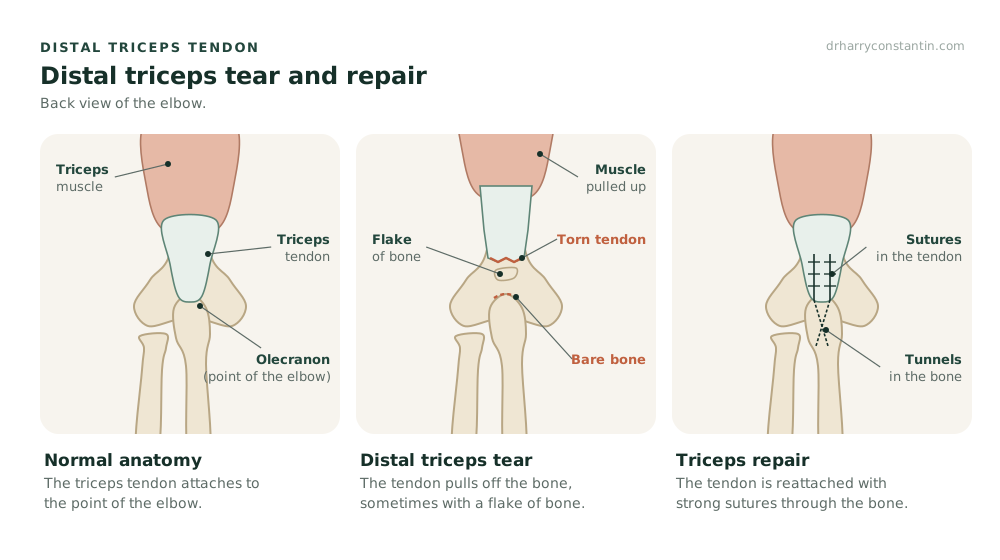
The triceps is the large muscle at the back of the upper arm. It straightens the elbow and is used for pushing, pressing and lifting the arm overhead. At its lower end, the triceps tendon attaches to the point of the elbow (the olecranon). A distal triceps tear happens when this tendon is partly or completely torn away from the bone.
Triceps tendon tears are uncommon, but they are becoming more frequent in people who lift weights and play sport. Early diagnosis matters, because complete tears are ideally repaired within the first few weeks after injury.
Types of triceps tear
- Partial tears. Part of the tendon is torn, but some of it remains attached to the bone and the elbow can still be straightened against resistance.
- Complete tears (ruptures). The whole tendon has pulled away from the bone, often with a small flake of bone. There is significant weakness straightening the elbow.
- Chronic tears. Tears that are diagnosed late, after the tendon has retracted and scarred. These are more difficult to repair and may need a tendon graft.
Common causes and risk factors
- Heavy lifting. Bench press, dips and push-ups, when the triceps is contracting while being forced to bend.
- Falls onto an outstretched hand. The most common cause outside the gym.
- Contact sport. Tackles and collisions in rugby, AFL and other contact sports.
- Direct blows. A blow to the back of the elbow.
The risk is higher with anabolic steroid use, previous cortisone injections into the tendon, olecranon bursitis, certain antibiotics (fluoroquinolones), and conditions such as kidney disease that weaken tendons.
Symptoms
- A sudden pop or tearing sensation at the back of the elbow
- Pain, swelling and bruising at the back of the elbow and upper arm
- Weakness straightening the elbow, particularly with the arm overhead
- A gap or dent above the point of the elbow where the tendon has pulled away
- Difficulty pushing up from a chair, doing push-ups or reaching overhead
Assessment
Your consultation includes a history of the injury and an examination of elbow strength, the tendon and the nerves around the elbow. Swelling can hide the gap, and some people with a complete tear can still straighten the elbow, so triceps tears are easy to miss and imaging is important. X-rays may show a small flake of bone pulled off with the tendon, a sign that almost always means the triceps has torn. An ultrasound or MRI confirms the diagnosis, shows whether the tear is partial or complete, and measures how far the tendon has retracted.
Non-surgical treatment
Partial tears involving less than half of the tendon are generally treated without surgery. Larger partial tears can also be treated without surgery in people who are less active. Treatment includes:
- A splint for about four weeks, with the elbow slightly bent (about 30°)
- Pain relief
- Physiotherapy to restore movement and gradually rebuild strength
- Regular review to make sure strength is returning
When is surgery recommended?
Surgery is usually recommended for:
- Complete tears of the triceps tendon
- Partial tears involving more than half of the tendon in active people, athletes and people whose work involves heavy pushing or lifting
- Partial tears that remain painful or weak despite non-surgical treatment
Repair is ideally performed within the first two to three weeks after injury, before the tendon retracts and scars. Please arrange a review as soon as possible if you think you have torn your triceps.
Triceps tendon repair surgery
Through an incision at the back of the elbow, the torn tendon is reattached to the olecranon using strong sutures passed through the bone and/or small anchors. The ulnar nerve, which runs close by on the inner side of the elbow, is protected throughout. For chronic tears where the tendon cannot be brought back to the bone, a tendon graft may be used to reconstruct it.
Surgery is performed under general anaesthetic, usually with a nerve block for pain relief. Most patients go home the same day or the next day, with the elbow in a plaster cast.
Repair gives good results. After repair of acute tears, strength recovered to about 92% of the other arm at one year, with a small loss of straightening of about 8 degrees (van Riet et al. 2003).
Recovery and rehabilitation
Recovery follows a staged program with your physiotherapist, protecting the repair while it heals to the bone and then gradually restoring movement and strength. Dr Constantin's Triceps Repair Rehabilitation Protocol is available on the Rehabilitation page. Please give a copy to your physiotherapist before your first appointment.
No weight-bearing through the arm, such as pushing up from a chair, for at least 12 weeks after surgery.
Risks
Triceps tendon repair is generally a safe operation. As with any surgery, there are risks, including:
- Elbow stiffness, particularly difficulty fully bending or straightening the elbow
- Re-rupture of the tendon, most often from a fall or loading the elbow too early
- Irritation of or injury to the ulnar nerve, causing numbness or tingling in the ring and little fingers
- Infection or wound problems at the back of the elbow
- Prominent or irritating sutures or anchors
- Anaesthetic complications
Dr Constantin will discuss all risks and expected outcomes prior to your surgery.
Frequently asked questions
How do I know if I've torn my triceps?
A pop at the back of the elbow, followed by pain, bruising and weakness straightening the arm, especially overhead, suggests a triceps tear. An ultrasound or MRI confirms the diagnosis.
Will a torn triceps heal on its own?
A complete tear will not reattach to the bone on its own, and usually leaves permanent weakness without surgery. Partial tears involving less than half of the tendon generally recover with a splint for about four weeks and physiotherapy.
How soon do I need surgery?
Ideally within two to three weeks of the injury. After this, the tendon retracts and scars, which makes repair more difficult and may require a graft.
How long will I be in a cast or brace?
A cast for the first one to two weeks, then a hinged brace that is gradually unlocked. Most people can stop wearing the brace between weeks 10 and 12.
When can I drive?
Not while you're in a cast or locked brace. Most people can drive once the brace is removed and they have enough movement and strength to control the car safely.
When can I return to work?
Desk work can often resume within one to two weeks. Manual work that involves lifting or pushing usually takes three to six months.
When can I return to the gym and bench press?
Light strengthening starts from about three months. Push-ups, bench press and heavy pressing are reintroduced gradually after six months, once strength has returned.
Is this covered by my health fund, WorkCover or CTP?
Dr Constantin operates at the Mater Hospital, North Sydney, for patients with private health insurance, workers compensation and CTP claims, and at Canterbury Hospital for Medicare-only patients. For costs and cover, see Health insurance & fees or call the rooms to talk through your options.
Do I need a referral?
Yes. You'll need a referral from your GP or another specialist to see Dr Constantin. Because early repair matters, contact the rooms as soon as possible after the injury. See Referrals.
Book an appointment
If you think you have torn your triceps tendon, early assessment is important. Please contact Dr Constantin for an assessment, or call (02) 9409 0503.
If you need surgery, it will be performed at the Mater Hospital (private health insurance, DVA, workers compensation and CTP) or Canterbury Hospital (Medicare).
Having surgery? Read Preparing for surgery for what to do in the weeks before your operation, including fasting, medicines and nutrition.
Related pages
The information on this page is general in nature and is not a substitute for individual medical advice. Recovery timeframes are a guide only and will be tailored to you.
Talk to Dr Constantin about your elbow
A GP or specialist referral is needed to claim a Medicare rebate. Consultations are available in North Sydney, Kogarah and Miranda.