
Think you've torn your pec? Early assessment matters. Call (02) 9409 0503 for an urgent appointment. The best results come from repair within the first few weeks.
Pectoralis major anatomy: why the pec tears where it does
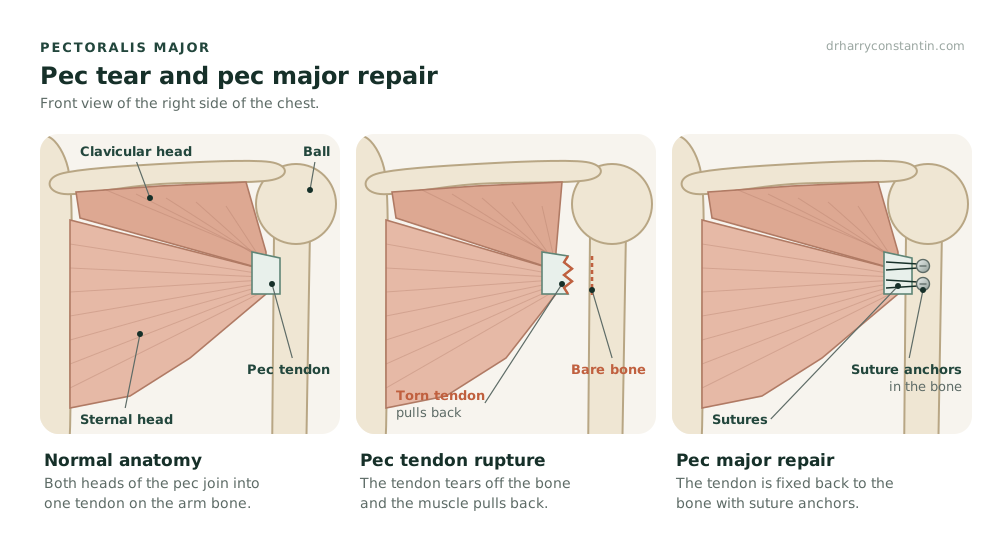
The pectoralis major is the large muscle of the chest. It has two heads: the clavicular head (upper chest), which starts at the collarbone, and the larger sternal head (mid and lower chest), which starts at the breastbone and ribs. The two heads twist and converge into a single flat tendon that inserts onto the front of the upper arm bone (humerus), just below the shoulder.
The pec brings the arm across the body, rotates it inwards and helps push forwards. These are the exact movements of the bench press, dumbbell press, flyes and dips. The lower sternal fibres are stretched the most at the bottom of a press, which is why they are usually the first to tear.
How pec tears happen in the gym
Most pec tears happen during an eccentric contraction. This is when the pec is working hard to push or hold a weight, but the load forces the arm out and back, so the muscle is lengthening as it pulls. On the bench press, this is typically lowering a heavy bar to the chest, when the arm is stretched out and rotated. The tendon cannot take the force and pulls off the bone.
It is the same mechanism as a distal biceps rupture at the elbow, another tendon injury common in lifters. Common causes of a pec tear include:
- Bench press: by far the most common cause, particularly heavy singles, low reps or a bar that drifts or drops at the bottom of the lift
- Dumbbell press and flyes: heavy dumbbells at full stretch
- Dips: deep, loaded dips with the shoulder extended
- Contact sport and trauma: tackling, wrestling, grappling, or bracing a fall
Who is at risk of a pec tear?
- Men aged roughly 20 to 40, particularly bodybuilders, powerlifters and strength athletes
- Lifters training heavy, low-rep pressing with fatigue or poor bar control
- Anabolic steroid use, where muscle strength outpaces tendon adaptation
- Smoking
- Previous pain or partial tearing in the pec tendon, or corticosteroid injections into the area
Pec tears can also happen in people with none of these risk factors.
Pec tear symptoms and signs
- A sudden tearing, popping or ripping sensation in the chest or front of the shoulder during a lift
- Immediate weakness pressing, bringing the arm across the body or rotating it inwards
- Rapid swelling of the chest and armpit
- Extensive bruising of the chest, armpit and upper arm, often tracking down the arm over several days
- Loss of the normal fold at the front of the armpit (anterior axillary fold)
- The nipple sitting lower than, or at a different level to, the other side
- A visible dent, bunching or asymmetry in the chest, especially when the pecs are squeezed together
Diagnosing a pectoralis major rupture
At your consultation Dr Constantin will discuss how the injury happened and examine the chest and shoulder. A simple test, pressing the palms together in front of the chest, contracts the pecs and often makes a tear clearly visible, with a loss of the normal armpit fold and bunching of the muscle.
An MRI scan is the key investigation. It shows exactly where the pec has torn and how badly, which determines the treatment:
- Tendon avulsion from the bone: the most common tear in lifters, usually best treated with surgical repair
- Tear at the muscle–tendon junction: often repairable, depending on the amount of tendon left
- Tear within the muscle belly: usually managed without surgery
The MRI also shows whether one or both heads are torn and whether the tear is partial or complete. Ultrasound can be useful in some cases.
Pec tear treatment: surgery or no surgery?
Non-surgical treatment
Partial tears, tears within the muscle belly and some tears in less active patients can be managed without surgery, with rest, a sling for comfort, ice, and a structured physiotherapy and strengthening program. However, a complete tendon rupture treated without surgery usually leaves permanent weakness in pressing and a visible change in the chest.
Pec major repair surgery
For bodybuilders, powerlifters and active people with a complete tendon tear, surgical repair gives the best chance of restoring full strength, the normal shape of the chest and a return to heavy lifting. Timing is important: repairing the tendon within the first few weeks, before it retracts and scars, gives the most reliable result.
What does the research show?
Most surgeons recommend repairing a complete pec tendon rupture in young, active people, because repair gives better strength and function than leaving it. One of the largest studies followed 257 young, active men in the military for an average of four years after pec repair (Nute et al., Journal of Bone and Joint Surgery, 2017). The bench press caused 61% of the tears. In summary:
- Return to full activity. 94% returned to their full pre-injury level of physically demanding military duty, on average about seven months after surgery. Pain and strength both improved.
- Re-rupture. The repair tore again in about 1 in 20 (5.4%), and about 1 in 30 needed a second repair.
- Other complications. About 1 in 4 had a complication of some kind. The most common were ongoing pain at the front of the shoulder (about 1 in 13), some remaining weakness (about 1 in 20) and wound problems needing a return to theatre (about 1 in 20).
- Timing. Repairs done more than six weeks after the injury did not do significantly worse, so a tear that is several weeks old is still worth repairing.
- Risk factors. Being significantly overweight (a BMI of 30 or more) and having an active mental health condition were linked to a lower chance of a full return to duty. The authors also suggest that muscle can outgrow what the tendon can take, particularly when bulking and with performance-enhancing drugs, although steroid use could not be measured in this study.
These results are in a young, fit military group, but they are similar to studies of athletes and lifters.
Pectoralis major repair surgery: what's involved
The operation is performed under a general anaesthetic, usually with a nerve block, through an incision at the front of the shoulder. The torn tendon is freed from scar tissue and brought back to its original attachment on the humerus. It is then fixed to the bone with strong suture anchors, giving a strong repair that allows early, protected movement. Most patients go home the same day or the following day.
Chronic pec tears and reconstruction
If the tear is several weeks or months old, the tendon may have retracted and scarred. These chronic pec tears can still be treated. Where the tendon cannot reach the bone, the repair can be augmented or reconstructed using a tendon graft, restoring strength and the shape of the chest.
Risks and complications
- Re-rupture of the repair (less than 5%), usually from lifting too heavy, too soon
- Stiffness of the shoulder
- Weakness, or incomplete recovery of strength, more likely with chronic tears
- Ongoing pain at the front of the shoulder
- Wound problems or a sensitive scar, occasionally needing further surgery
- Nerve injury, infection and blood clots (rare)
Dr Constantin will discuss all risks and expected outcomes prior to your surgery.
Pec repair recovery: your road back to the bench
Rehabilitation follows Dr Constantin's Pectoralis Major Repair Rehabilitation Protocol, supervised by your physiotherapist. Exercises are done three times daily, five days a week. The biggest risk to your repair is doing too much too early. The timeline is designed to protect the tendon while it heals to the bone.
The full protocol is available on the Rehabilitation page for you and your physiotherapist.
Loading guide after pec repair
| Timeframe | Maximum load |
|---|---|
| First 12 weeks | Light load only: ½–1 kg or a light Theraband |
| After 12 weeks | Moderate load, if pain-free |
| 6 months + | Heavy and overhead work, including heavy pressing, only once cleared |
Returning to bench press after pec repair
Every lifter wants to know when they can bench again. The focus is on form and function, rather than maximal lifting. As a guide:
- 0–3 months: no pressing. Protect the repair and restore movement. Lower-body training and cardio can continue if the arm is protected.
- 3 months: modified press patterns begin, with light, controlled movements such as push-up progressions, light dumbbells and machines with a limited range.
- 3–6 months: gradual build in load, if pain-free. Avoid deep stretch positions, flyes and dips.
- 6 months +: heavier pressing reintroduced gradually, with good technique, once cleared by Dr Constantin and your physiotherapist. Maximal lifts are not the goal.
- 6–9 months: full return to training and sport for most lifters, with the emphasis on controlled form rather than chasing a one-rep max.
Tips to protect your pec when you return
- Build load gradually and avoid chasing a one-rep max early
- Use a controlled eccentric, and avoid bouncing the bar off the chest
- Keep elbows tucked around 45° rather than flared out, and consider a slightly narrower grip
- Use a spotter for heavy sets and stop before technical failure
- Treat new pain at the front of the armpit as a warning sign and get it checked
Work: desk work often within 1–2 weeks (one-handed); heavy manual or overhead work delayed for at least 6 months.
Frequently asked questions
Do I need surgery for a torn pec?
For complete tears of the tendon off the bone, particularly in bodybuilders, powerlifters and anyone who wants to get back to heavy pressing, surgical repair gives the best results for strength, chest shape and return to lifting. Partial tears and tears within the muscle belly are often managed without surgery.
How soon should a torn pec be repaired?
As soon as practical, ideally within the first few weeks. The tendon retracts and scars over time, making repair more difficult. Acute repairs generally give better strength and cosmetic results than delayed repairs, although chronic tears can still be reconstructed, sometimes with a tendon graft.
How long after pec repair can I bench press?
Light pressing patterns begin from around three months. Progressive loading continues from there, with heavier pressing delayed for at least six months and only once cleared. The focus is on form and function, rather than maximal lifting. Most lifters return to full training at six to nine months.
Will I get my strength back?
Most patients who have their pec repaired regain close to normal strength and return to lifting and sport. Without repair, a complete tear typically leaves a permanent loss of pressing strength and a visible change in the chest.
Will my chest look normal after surgery?
Repair restores the normal contour of the chest and armpit fold in most patients. A tear left unrepaired usually leaves a visible defect, a lack of the normal armpit fold and an asymmetrical chest, particularly when the muscle is contracted.
Did steroids cause my pec tear?
Anabolic steroid use is a recognised risk factor, as muscle strength can increase faster than the tendon can adapt. However, pec tears also occur in lifters who have never used them. Continuing anabolic steroids after a repair may also increase the risk of re-rupture. Please tell Dr Constantin about any supplements or steroids you use. This is confidential and helps plan safe surgery and recovery.
How long will I be in a sling?
The sling is worn at all times for the first four weeks, then weaned between weeks five and eight.
When can I go back to work?
Desk work is usually possible within one to two weeks, working one-handed in the sling. Heavy manual or overhead work usually needs to be delayed for at least six months.
Can I train the rest of my body while I recover?
Yes. Legs and lower-body training, plus cardio, can continue with care, provided the repaired arm is protected and no load goes through it. Light cardiovascular exercise in the sling can start from around five weeks. Avoid anything that braces, pulls or pushes through the operated arm until cleared.
Is this covered by my health fund, WorkCover or CTP?
Dr Constantin operates at the Mater Hospital, North Sydney, for patients with private health insurance, workers compensation and CTP claims, and at Canterbury Hospital for Medicare-only patients. For costs and cover, see Health insurance & fees or call the rooms to talk through your options.
Book an appointment
If you've felt a tear in your chest on the bench, or have bruising and a change in the shape of your chest after a lift, get it assessed early. Urgent appointments are available for acute injuries. Please contact Dr Constantin for an assessment, or call (02) 9409 0503.
If you need surgery, it will be performed at the Mater Hospital or Canterbury Hospital.
Related pages
The information on this page is general in nature and is not a substitute for individual medical advice. Recovery timeframes are a guide only and will be tailored to you.
Torn your pec? Talk to Dr Constantin
A GP or specialist referral is needed to claim a Medicare rebate. Consultations are available in North Sydney, Kogarah and Miranda.