What is the AC joint?
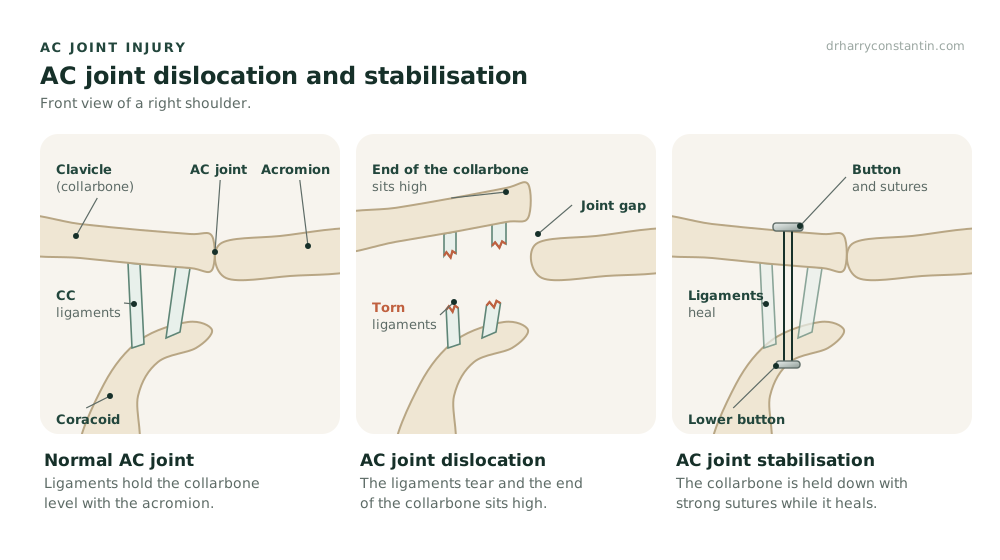
The acromioclavicular (AC) joint is the small joint at the top of the shoulder, where the outer end of the collarbone (clavicle) meets the acromion, the bony tip of the shoulder blade. You can feel it as a small bump on top of the shoulder.
Two sets of ligaments hold the joint together:
- The AC joint capsule and ligaments. These wrap around the joint itself, particularly on its upper and back surfaces, and stop the collarbone sliding forwards and backwards (horizontal stability).
- The coracoclavicular (CC) ligaments. Two strong ligaments, the conoid and the trapezoid, run from the underside of the collarbone down to a hook of bone on the shoulder blade called the coracoid. They stop the collarbone riding upwards (vertical stability).
How badly each set of ligaments is torn decides how unstable the joint is, and whether it is likely to settle without surgery.
How AC joint injuries happen
Most AC joint injuries are caused by a fall directly onto the point of the shoulder with the arm by the side. This drives the shoulder blade downwards while the collarbone stays in place.
Although it looks as though the collarbone has jumped up, it is better to think of it the other way round: the collarbone hasn't really gone up, the weight of the arm is pulling the shoulder down. The bump on top of the shoulder is the end of the collarbone left behind.
AC joint injuries are common in:
- Cycling and mountain biking
- Rugby, AFL and other contact sports
- Skiing, snowboarding and horse riding
- Falls at work or at home
Types of AC joint injury
AC joint injuries are graded from type I to type VI by how badly the ligaments are torn and how far the collarbone has moved:
- Type I (sprain). The AC ligaments are stretched but not torn. The joint stays in place.
- Type II (partial tear). The AC ligaments are torn but the CC ligaments are intact. There may be a small step at the joint.
- Type III (complete dislocation). Both the AC and CC ligaments are torn, and the end of the collarbone sits higher than the acromion. On X-ray it is displaced by less than 100% compared with the other side.
- Type IV. The end of the collarbone is pushed backwards and becomes fixed behind, in the muscle at the back of the shoulder. This usually restricts lifting the arm forwards (forward elevation).
- Type V. A more severe form of type III. The muscles around the collarbone are also torn, and on X-ray it is displaced by more than 100% compared with the other side, leaving a large bump under the skin.
- Type VI. The collarbone is pushed down under the coracoid. This is very rare and usually happens as part of a major, multiple injury.
Fractures of the outer end of the collarbone
Some fractures of the outer end of the collarbone also tear the CC ligaments, so the collarbone is pulled upwards. These behave like an AC joint dislocation and usually need surgery. See Clavicle fracture.
Symptoms
- Pain on the top of the shoulder straight after a fall
- Swelling and bruising over the joint
- A bump or step on top of the shoulder where the collarbone has lifted
- Pain lifting the arm or reaching across the body
- Difficulty sleeping on the injured side
Assessment
Your consultation includes a history of the injury and an examination of the joint, its stability and the rest of the shoulder, including how well the shoulder blade moves.
X-rays of both shoulders show how far the collarbone has moved. A tilted view of the joint (Zanca view) and a view taken with the arm across the body (Alexander view) help show whether the joint is unstable up and down, front to back, or both. An MRI or CT scan is sometimes used to look for other injuries in the shoulder.
Other injuries inside the shoulder can happen at the same time, such as a SLAP tear or a tear of the labrum (the rim of cartilage around the socket). These are not always obvious at the time of the AC joint separation, and may only become apparent later if pain or clicking continues deep in the shoulder.
The decision about treatment is based on the type of injury on X-ray, the examination, and your symptoms.
Non-surgical treatment
Most AC joint injuries are managed without surgery, including most type III injuries and type V injuries that are stable front to back:
- A sling for comfort, usually for one to two weeks
- Ice and pain relief
- Physiotherapy to restore movement and strengthen the shoulder blade (scapular) and rotator cuff muscles
- A gradual return to work and sport as pain allows
A bump on top of the shoulder may remain, but it usually doesn't affect how the shoulder works.
Milder injuries are not always trivial. In one long-term study of type I and II injuries (Mouhsine 2003), about half of patients had no symptoms at around six years, but about 1 in 4 developed ongoing joint problems that needed surgery. The ongoing problem is usually arthritis of the AC joint, which, if it is troublesome enough, can be treated with keyhole surgery to remove the worn end of the collarbone (distal clavicle excision).
When is surgery recommended?
In Dr Constantin's practice, surgery is usually only recommended for:
- Type IV injuries, where the collarbone is pushed backwards and fixed behind.
- Type V injuries with both vertical and horizontal instability, where the joint is unstable up and down and front to back. The front-to-back (horizontal) instability usually restricts lifting the arm forwards, because the end of the collarbone catches on the back of the acromion as the arm is raised.
- Type VI injuries, which are very rare.
- Some fractures of the outer end of the collarbone that behave like an AC joint dislocation.
The decision is based on the X-rays, the examination, and your signs and symptoms. Most other AC joint injuries, including most type III injuries and type V injuries that are stable front to back, are best managed without surgery, and the research supports this.
If pain, weakness or instability continue despite a good period of rehabilitation, surgery can still be considered later.
What to expect with and without surgery
Without surgery, the end of the collarbone usually settles a little lower over time as the torn ligaments scar down. It never returns completely to normal, so there will always be a bump, with the collarbone sitting a little higher than on the other side.
With surgery, the collarbone is brought back into position, but the repair or reconstruction often stretches out a little over time, so some of the bump can return.
In the long run, the two often end up somewhere in between. Provided your shoulder isn't painful and you have a full range of movement, surgery is not necessarily needed.
What does the research show?
Several randomised trials have compared surgery with a sling and early physiotherapy for complete AC joint dislocations (COTS 2015, ACORN 2018, Boström Windhamre 2022 and Tauber 2023). In summary:
- Faster recovery without surgery. Rehabilitating the shoulder straight away means return to work and normal function is quicker. In one trial, about 3 in 4 people treated without surgery were back at work at three months, compared with about 4 in 10 after surgery.
- Similar results by one to two years. Shoulder function is usually the same with or without surgery, and close to normal.
- Delayed surgery still does well. If surgery is needed later, the results are still good (Lädermann 2021).
- Appearance. The joint more often looks normal after surgery, but this did not translate into better function.
AC joint reconstruction surgery
The aim of surgery is to bring the end of the collarbone back down into its normal position and hold it there while the ligaments heal. For acute injuries, Dr Constantin uses one or both of the following:
- Arthroscopic (keyhole) stabilisation with a suture button. The collarbone is held down to the coracoid with very strong sutures and small metal buttons, placed through small incisions.
- A hook plate. A plate is fixed to the top of the collarbone, and its hook sits under the acromion to hold the collarbone down while the ligaments heal. Because the hook sits under the acromion, it can wear the acromion or irritate the rotator cuff, so the plate is removed once the ligaments have healed, at around three months.
Dr Constantin will discuss the best option for your injury, and what to expect from surgery and recovery.
Recovery and rehabilitation
Rehabilitation follows Dr Constantin's ACJ Stabilisation Rehabilitation Protocol and is supervised by your physiotherapist. Recovery is individualised, and the timeframes are a guide that may need extending.
The full protocol is available on the Rehabilitation page for you and your physiotherapist.
- Weeks 0–6: sling day and night, removed for showers. Gentle assisted movement only, with no reaching across the body.
- Weeks 7–12: the sling is weaned and movement is gradually restored. Reaching across the body can start from around week 8. Light cardio such as treadmill running from weeks 10–12. No strengthening yet.
- 3 months +: strengthening begins and is built up gradually, with work- and sport-specific exercises. If you have a hook plate, it is removed at around this time.
- 4–6 months +: return to sport and gym weights once strength and movement milestones are reached. Bench press and shoulder press are avoided until cleared.
Risks
AC joint stabilisation is a common operation. As with any surgery, there are risks, including:
- The collarbone lifting again (loss of reduction), so that a bump returns. This is common to some degree, but does not usually affect function
- Stiffness of the shoulder
- Prominent or irritating buttons or sutures, which occasionally need removing
- With a hook plate, wear of the acromion or irritation of the rotator cuff, and a second operation to remove the plate
- Fracture of the collarbone or coracoid around the fixation (uncommon)
- Infection or wound problems
- Nerve or blood vessel injury (rare)
- Anaesthetic complications
Dr Constantin will discuss all risks and expected outcomes prior to your surgery.
Frequently asked questions
Do all AC joint injuries need surgery?
No. Most AC joint injuries, including most type III injuries and type V injuries that are stable front to back, recover well with a short period in a sling and physiotherapy. Surgery is usually only recommended for type IV injuries, type V injuries that are unstable both up and down and front to back, and the rare type VI injury.
Will the bump on my shoulder go away?
Without surgery, a bump usually remains where the collarbone has lifted, but it doesn't usually affect how the shoulder works. Surgery aims to bring the collarbone back down into position.
Can I have surgery later if it doesn't settle?
Yes. If pain, weakness or instability continue despite a good period of rehabilitation, surgery can be considered later, and studies suggest delaying it does not worsen the result.
Why does the hook plate need to come out?
The hook sits under the acromion, the bony tip of the shoulder. Left in, it can wear the acromion or irritate the rotator cuff, so it is removed once the ligaments have healed, at around three months.
How long will I be in a sling?
Without surgery, usually one to two weeks for comfort. After surgery, at least six weeks, day and night. It can come off for showers and your exercises.
When can I return to work?
After surgery, desk work is usually possible from around two weeks, if you can manage in the sling. Heavy manual work usually needs four to six months off.
When can I return to sport and the gym?
After surgery, light cardio such as running can usually start from 10 to 12 weeks. Return to sport and weights is usually from four to six months, once strength and movement milestones are reached. Bench press and shoulder press are avoided until Dr Constantin clears you.
When can I drive?
Not while you are wearing the sling. Most people can drive once the sling is off and they can control the car safely. Check with your insurer.
Is this covered by my health fund, WorkCover or CTP?
Dr Constantin operates at the Mater Hospital, North Sydney, for patients with private health insurance, workers compensation and CTP claims, and at Canterbury Hospital for Medicare-only patients. For costs and cover, see Health insurance & fees or call the rooms to talk through your options.
Do I need a referral?
Yes. You'll need a referral from your GP or another specialist to see Dr Constantin. See Referrals.
Book an appointment
If you have injured the top of your shoulder, or have a painful bump after a fall, Dr Constantin can assess the injury and recommend the right treatment. Please contact Dr Constantin for an assessment, or call (02) 9409 0503.
If you need surgery, it will be performed at the Mater Hospital or Canterbury Hospital.
Related pages
The information on this page is general in nature and is not a substitute for individual medical advice. Recovery timeframes are a guide only and will be tailored to you.
Talk to Dr Constantin about your shoulder
A GP or specialist referral is needed to claim a Medicare rebate. Consultations are available in North Sydney, Kogarah and Miranda.