
What is frozen shoulder?
Frozen shoulder (adhesive capsulitis) is a problem unique to the shoulder capsule, the lining of the shoulder joint. Inflammation in the capsule causes it to scar and tighten, which leads to pain and stiffness.
It shows up as shoulder pain with movement that becomes more and more restricted. Both lifting the arm yourself and having someone else move it are limited, and turning the arm outwards is usually the first movement to be lost. X-rays of the shoulder are normal.
Frozen shoulder is more common in women, and it often starts for no obvious reason.
Who gets frozen shoulder? Diabetes and thyroid problems
Frozen shoulder affects about 2% to 5% of people. It is more common in women. Other risk factors include:
- Diabetes: people with diabetes are about five times more likely to get frozen shoulder. The risk is higher the longer you have had diabetes and the poorer your blood sugar control, and people with diabetes tend to get it at a younger age.
- Thyroid problems: an overactive thyroid (hyperthyroidism) is an independent risk factor.
- Previous surgery: frozen shoulder can follow surgery on the shoulder (even rotator cuff repair), breast or neck.
- Previous injury: frozen shoulder can happen after a rotator cuff tear or a fracture around the shoulder.
If you have frozen shoulder, it is worth asking your GP to check your blood sugar and thyroid, as an undiagnosed problem may be found. If you have diabetes, good blood sugar control is important for your general health and your recovery.
The three phases of frozen shoulder
Frozen shoulder usually passes through three phases. They often overlap, and the timing varies from person to person.
- Freezing: the phase marked by pain and increasing stiffness.
- Frozen: the pain goes away, but the shoulder stays stiff.
- Thawing: the scarred capsule and the inflammation break down. You may get more pain during this phase, but your movement comes back.
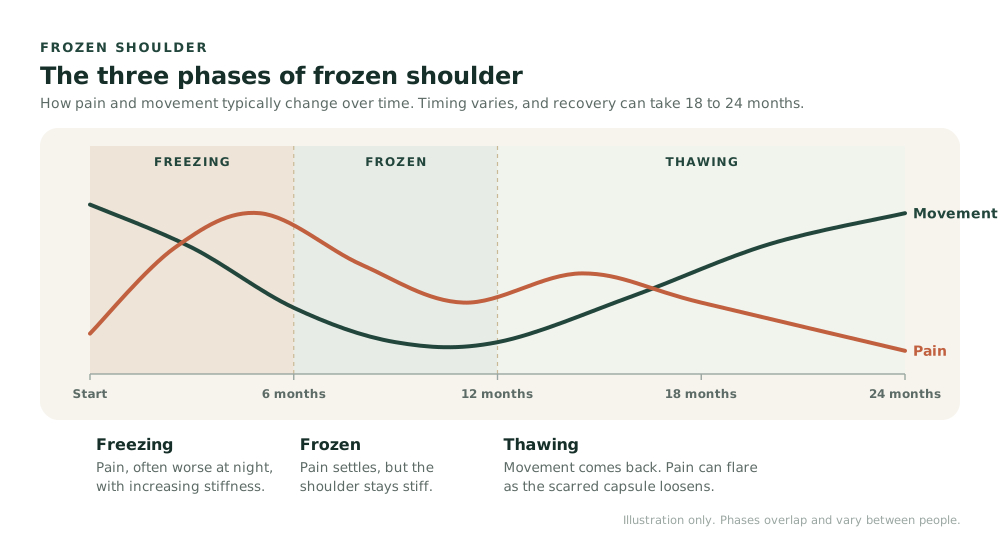
Frozen shoulder is very difficult to treat, and it can take 18 to 24 months to get better.
How is frozen shoulder treated?
The main way to treat frozen shoulder is without surgery. Treatment aims to settle the pain and help you keep moving while the condition runs its course. In the first phases, these can help:
- Corticosteroid (cortisone) injection: an injection into the shoulder joint to reduce the inflammation and pain. It works best early, in the first year.
- Hydrodilatation: an injection of fluid and corticosteroid into the joint, guided by imaging, to stretch the tight capsule.
- Physiotherapy and a home exercise program: gentle stretches and range of motion exercises to keep the shoulder moving.
- Pain relief: simple pain medicines to help you sleep and stay active.
Surgery is reserved for stiffness that will not settle despite these treatments. It can release the tight capsule to improve movement, but it does not get rid of the pain of frozen shoulder.
What does the research show?
A large 2020 review of treatments for frozen shoulder brought together 65 randomised trials with more than 4,000 patients (Challoumas et al. 2020). It found that:
- for people who have had frozen shoulder for less than 1 year, a corticosteroid injection into the joint gave the greatest benefit of all the treatments studied, with less pain and better function
- the injection worked better than no injection at all, and better than physiotherapy alone, with benefits that can last up to 6 months
- adding a home exercise program of simple stretches and range of motion exercises gave added benefit, and physiotherapy may help further
It is important to know that frozen shoulder does get better with time.
Frequently asked questions
What is frozen shoulder?
Frozen shoulder (adhesive capsulitis) is inflammation and scarring of the shoulder capsule, the lining of the shoulder joint. It causes pain and stiffness that steadily get worse, and then slowly recover.
Is frozen shoulder linked to diabetes or thyroid problems?
Yes. People with diabetes are about five times more likely to get frozen shoulder, and an overactive thyroid also increases the risk. If you have frozen shoulder, it is worth asking your GP to check your blood sugar and thyroid.
How long does frozen shoulder last?
It usually passes through three phases, freezing, frozen and thawing, and can take 18 to 24 months to get better. The timing varies from person to person.
Will frozen shoulder get better on its own?
In most people frozen shoulder does improve with time. Treatment such as a corticosteroid injection and exercises can ease the pain and help you keep moving while it recovers.
Does a cortisone injection help frozen shoulder?
Yes. Research shows that a corticosteroid injection into the shoulder joint, given in the first year and combined with a home exercise program, gives the most benefit of the non-surgical treatments.
Do I need surgery for frozen shoulder?
Rarely. Surgery is reserved for stiffness that does not settle with other treatment. It can improve movement, but it does not get rid of the pain of frozen shoulder.
Do I need a referral?
Yes. You'll need a referral from your GP or another specialist to see Dr Constantin. See Referrals.
Book an appointment
If you have a painful, stiff shoulder, Dr Constantin can confirm whether it is frozen shoulder and talk through your treatment options. Please contact Dr Constantin for an assessment, or call (02) 9409 0503.
If you need surgery, it will be performed at the Mater Hospital (private health insurance, DVA, workers compensation and CTP) or Canterbury Hospital (Medicare).
Related pages
The information on this page is general in nature and is not a substitute for individual medical advice. Recovery timeframes are a guide only and will be tailored to you.
Book a shoulder assessment
A GP or specialist referral is needed to claim a Medicare rebate. Consultations are available in North Sydney, Kogarah and Miranda.