
What is a proximal humerus fracture?
The humerus is the upper arm bone. Its top end (the proximal humerus) forms the ball of the shoulder joint. A proximal humerus fracture is a break in this part of the bone, and is often called a broken shoulder.
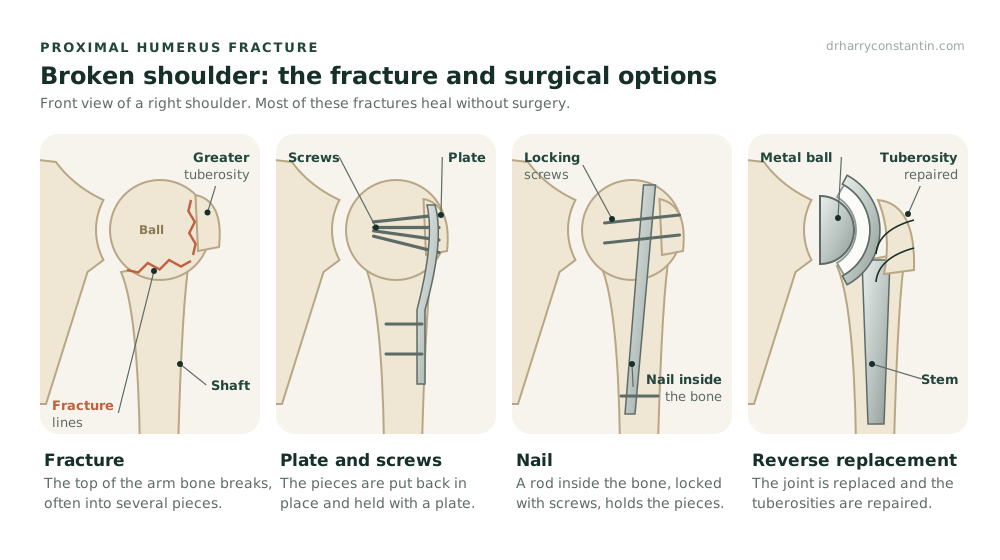
The top of the humerus has four main parts: the ball (humeral head), the greater and lesser tuberosities, where the rotator cuff tendons attach, and the shaft. Fractures are described by how many of these parts have broken off and moved out of position.
Who gets a proximal humerus fracture?
Proximal humerus fractures are one of the most common fractures in older adults, particularly women, as osteoporosis makes the bone weaker. In older people, they usually follow a simple fall from standing height onto the arm or shoulder.
In younger people, much more force is usually needed, such as a fall from a bike or a height, a sporting collision or a car accident.
Types of fracture
- Undisplaced fractures. The bone is broken but the pieces have stayed in a good position. These are the most common, and almost always heal without surgery.
- Displaced fractures. One or more parts have moved out of position. They are described as two-, three- or four-part fractures, depending on how many parts are involved.
- Fracture-dislocations. The ball has also come out of the socket.
- Head-split and anatomic neck fractures. Fractures through the ball itself, which can damage its blood supply.
Symptoms
- Pain in the shoulder and upper arm, usually straight after a fall
- Swelling and extensive bruising, which often spreads down the arm to the elbow and sometimes onto the chest over the following days
- Being unable to lift or move the arm
- A grinding sensation with movement
Seek urgent medical attention if you have numbness, tingling, weakness or coldness in the arm or hand, if the skin is broken, or if the shoulder looks dislocated.
Assessment
Your consultation includes a history of the injury, your general health and your usual activities, and an examination of the shoulder, the nerves (particularly the axillary nerve, which supplies the deltoid muscle) and the circulation of the arm.
X-rays taken from several angles show the fracture pattern and how much the pieces have moved. A CT scan is often used for more complex fractures to understand the pieces in three dimensions and plan treatment. If you are over 50 and broke your shoulder in a fall, a bone density check is recommended to look for osteoporosis.
Non-surgical treatment
Most proximal humerus fractures do well without surgery, particularly when the pieces have not moved much. Treatment includes:
- A sling for comfort, usually for two to four weeks
- Pain relief, which is often needed regularly for the first few weeks
- Early gentle movement, starting with pendulum exercises, then a guided physiotherapy program to restore movement and strength
- Keeping the elbow, wrist and hand moving to prevent stiffness
- Follow-up X-rays to check the fracture is healing in a good position
Most fractures heal in around three to four months, and the shoulder continues to improve for up to a year.
Whether or not you need surgery, your recovery will follow Dr Constantin's Proximal Humeral Fracture Rehabilitation Protocol, guided by your physiotherapist. Please give a copy to your physiotherapist before your first appointment.
Choosing the right treatment
The best treatment depends on the type of fracture, your age, the quality of your bone and your functional goals, such as work, sport and independence at home. Dr Constantin will explain the options with you, including the option of not having surgery, so that the treatment matches your needs.
When is surgery recommended?
Surgery may be recommended when:
- The pieces have moved significantly, particularly in younger and more active people
- The fracture is combined with a dislocation
- The fracture goes through the ball, or the ball has lost its blood supply
- The greater tuberosity has pulled away, affecting the rotator cuff
- The skin is broken, or there is injury to nerves or blood vessels
- The fracture has not healed (non-union) or has healed in a poor position and is causing problems
Surgical options
Plate and screws
Through an incision at the front of the shoulder, the pieces are put back into position and held with a plate and screws shaped to fit the top of the humerus. This aims to let the bone heal in a good position, and is often used in younger people and those with good bone quality.
Intramedullary nail
A metal rod (nail) is passed down the inside of the bone through a small incision at the top of the shoulder, and locked in place with screws. It is suited to some fractures where the ball is in one piece and the break is lower down, at the neck of the humerus.
Reverse shoulder replacement with tuberosity reconstruction
For complex fractures in older patients, particularly when the bone is weak or the ball has broken into several pieces, a reverse total shoulder replacement may be the best option. The broken ball is replaced, and the tuberosities, with their rotator cuff tendons attached, are repaired around the implant. Because a reverse replacement does not rely on the rotator cuff, it gives a more predictable result than trying to fix very small or fragile pieces of bone.
The biceps tendon
With each of these operations, the long head of the biceps tendon, which runs through the shoulder joint, is usually tenodesed. The tendon is released from inside the joint and fixed to the arm bone, so that it does not cause pain or other problems later. See Biceps tenodesis.
Recovery and rehabilitation
Rehabilitation follows Dr Constantin's Proximal Humeral Fracture Rehabilitation Protocol and is supervised by your physiotherapist. Recovery is individualised to your fracture, the type of fixation, your age and any other procedures performed. Bone healing can be slow, so the timeframes are a guide and may need extending.
The full protocol is available on the Rehabilitation page for you and your physiotherapist.
- Weeks 0–6: after surgery, the sling is worn day and night, removed for showers. Pendulum exercises from the start, then gentle assisted movement from week 3. No lifting.
- Weeks 7–12: movement is gradually restored with light exercises. Desk or light work is usually possible from 6–8 weeks.
- 3–6 months: progressive strengthening, with loads kept light for the first 12 weeks.
- 6 months +: heavy, overhead and sporting activities are reintroduced gradually, once strength has returned.
Risks and complications
Whether or not surgery is needed, a broken shoulder can cause problems, including:
- Stiffness, ranging from mild loss of movement to a frozen shoulder
- Ongoing pain or weakness
- The fracture not healing (non-union), or healing in a poor position (malunion)
- Loss of blood supply to the ball (avascular necrosis), more likely with complex fractures, which can lead to collapse and arthritis
Surgery carries additional risks, including infection, nerve injury (particularly the axillary nerve), screws loosening or cutting through weak bone, prominent metalwork, and the need for further surgery. Dr Constantin will discuss the risks and expected outcomes of each option with you.
Frequently asked questions
Do I need surgery for a broken shoulder?
Most proximal humerus fractures heal well without surgery, with a sling and physiotherapy. Surgery is considered when the pieces have moved significantly, the shoulder is dislocated, or the ball is badly broken, taking into account your age, bone quality and goals.
How long does a broken shoulder take to heal?
Most fractures heal in around three to four months. The shoulder continues to improve for up to a year, and some stiffness or reduced strength can remain.
How long will I wear a sling?
Without surgery, usually two to four weeks for comfort. After surgery, the sling is usually worn for around six weeks.
Why is my whole arm bruised?
Bleeding from the fracture tracks down the arm under the skin, so bruising often spreads to the elbow and forearm, and sometimes onto the chest. This is normal and settles over a few weeks.
When can I drive?
Not while you are wearing the sling. Most people can drive once the sling is off and they have enough movement and strength to control the car safely. For general advice, see When can I drive after surgery? in the questions on the home page.
When can I return to work?
Desk or light work is usually possible from around six to eight weeks. Heavy manual or overhead work usually takes four to six months.
Should I have my bones checked?
Yes, if you are over 50 and broke your shoulder in a fall. A bone density scan can check for osteoporosis, and treatment can reduce the risk of future fractures. Your GP can arrange this.
I was injured in a car or motorbike accident. Can you treat me under CTP?
Yes. Dr Constantin treats CTP and workers compensation patients at the Mater Hospital, North Sydney.
Is this covered by my health fund, WorkCover or CTP?
Dr Constantin operates at the Mater Hospital, North Sydney, for patients with private health insurance, workers compensation and CTP claims, and at Canterbury Hospital for Medicare-only patients. For costs and cover, see Health insurance & fees or call the rooms to talk through your options.
Do I need a referral?
Yes. You'll need a referral from your GP or another specialist to see Dr Constantin. If you have been seen in an emergency department, please bring your X-rays and any scans to your appointment. See Referrals.
Book an appointment
Broken shoulders are best assessed early, ideally within the first week or two after the injury. Please contact Dr Constantin for an assessment, or call (02) 9409 0503.
If you need surgery, it will be performed at the Mater Hospital or Canterbury Hospital.
Related pages
The information on this page is general in nature and is not a substitute for individual medical advice. Recovery timeframes are a guide only and will be tailored to you.
Talk to Dr Constantin about your shoulder
A GP or specialist referral is needed to claim a Medicare rebate. Consultations are available in North Sydney, Kogarah and Miranda.